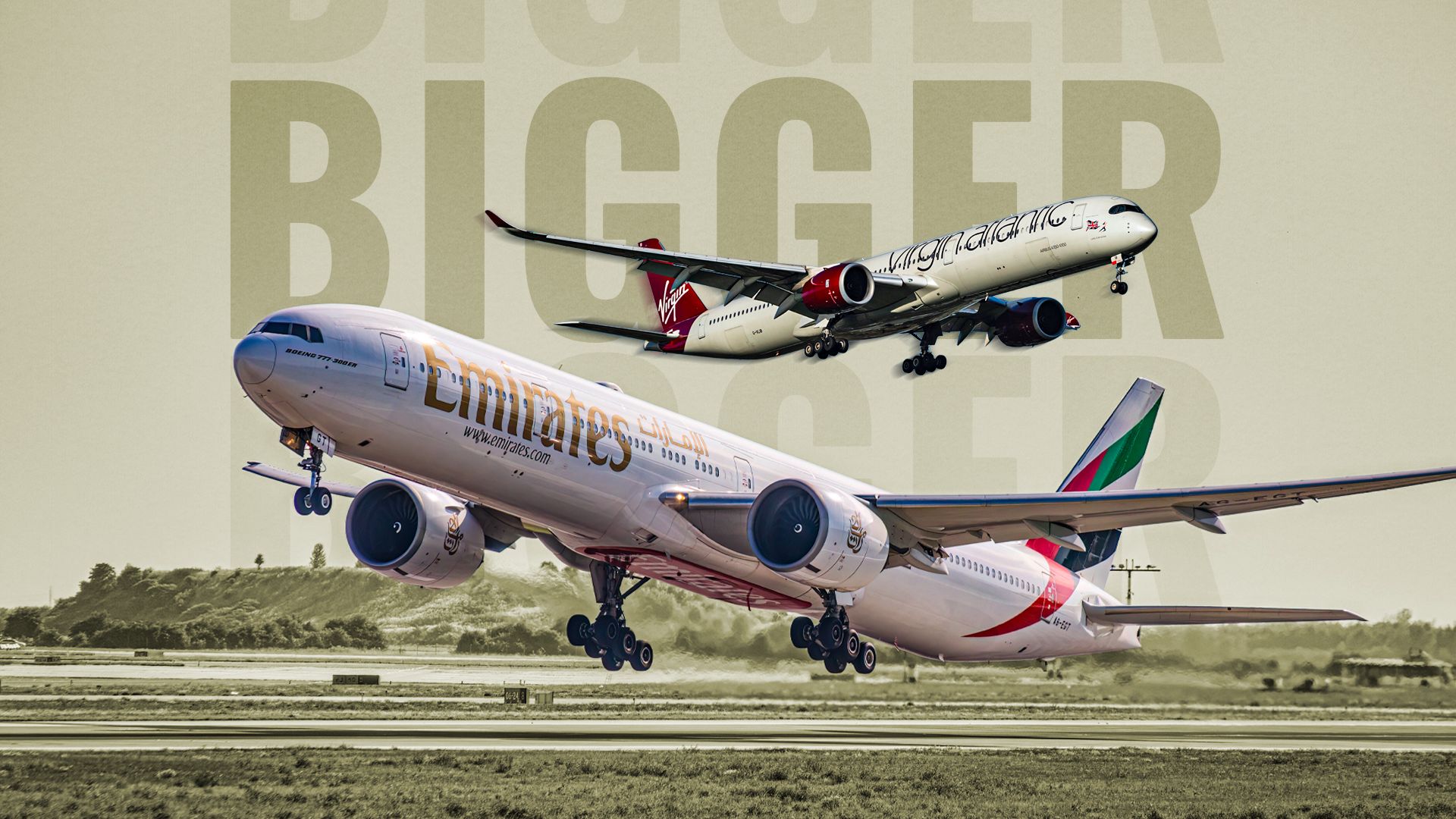
The aviation industry often draws comparisons between its flagship aircraft, particularly the Boeing 777-300ER and the Airbus A350. Examining these two models reveals significant differences in size, capacity, and operational capabilities. While both aircraft are impressive in their own right, the Boeing 777-300ER stands out as the larger of the two, with distinct advantages in weight and payload.
Understanding the Boeing 777-300ER
The Boeing 777-300ER, which entered service in 2004, represents a hallmark of modern aircraft design. With a length of approximately 242 feet 4 inches (74 meters), it ranks among the largest twin-engine passenger jets ever manufactured. This aircraft boasts a massive wingspan of 212 feet 7 inches (64.8 meters) and a tail height of 60 feet 8 inches (18.5 meters). Its power is derived from two General Electric GE90-115B engines, each producing around 115,000 pounds (52,200 kilograms) of thrust, making them the most powerful engines ever certified for commercial use.
The 777-300ER has a maximum takeoff weight (MTOW) of approximately 775,000 pounds (351 tonnes), allowing it to carry up to 400 passengers in a typical two-class configuration. Its range extends up to about 7,370 nautical miles (13,650 kilometers), making it capable of connecting major long-haul routes worldwide. Given its size and capacity, the aircraft has become a backbone for numerous airlines, particularly for high-demand routes.
The Airbus A350: A New Generation
In contrast, the Airbus A350, introduced in 2015, was designed with a focus on efficiency and passenger comfort. The baseline A350-900 stretches 220 feet (66.8 meters) in length, while the stretched A350-1000 measures around 242 feet 1 inch (73.8 meters). Both variants feature a wingspan of approximately 212 feet (64.75 meters), yet the A350 stands out due to its advanced materials and aerodynamics, which enhance fuel efficiency.
Typically, the A350-1000 can accommodate between 350 and 410 passengers in a three-class configuration, with a maximum takeoff weight of 679,000 pounds (308 tonnes). The range of the A350 varies from 8,000 to 8,700 nautical miles (14,800 to 16,100 kilometers), allowing for extensive operational flexibility. The A350’s design emphasizes passenger comfort, offering a quieter cabin and wider seats in an economy configuration.
Comparative Analysis of Specifications
When comparing the specifications of the Boeing 777-300ER and the Airbus A350-1000, nuances in performance emerge. The Boeing 777-300ER is indeed slightly longer, but it is also significantly heavier, with a MTOW that exceeds the A350-1000 by nearly 100,000 pounds (45 tonnes). This weight translates into greater cargo capacity and a more robust structural design.
Engine thrust is another area of differentiation. The GE90 engines of the 777-300ER provide substantially more thrust than the Rolls-Royce Trent XWB-97 engines found on the A350-1000, which generate around 97,000 pounds (43,900 kilograms) of thrust. This difference in power and capacity is pivotal for airlines that prioritize cargo and passenger numbers on their long-haul flights.
Market Presence and Operator Preferences
The Boeing 777-300ER has established itself as an industry staple with over 800 units delivered globally. Emirates, for instance, operates more than 120 of these aircraft, utilizing them for long-haul connections. Other major operators include Qatar Airways, Air France, and British Airways, who leverage the aircraft’s capabilities for high-demand routes.
Conversely, the Airbus A350 has gained significant traction since its introduction, with more than 630 units in service across approximately 33 airlines as of early 2025. Notable operators include Singapore Airlines and Cathay Pacific, with some airlines like Delta Air Lines opting for the A350 over the 777-300ER as their long-haul flagship.
Conclusion: Distinct Roles in Aviation
Both the Boeing 777-300ER and the Airbus A350 serve crucial roles in global aviation, catering to different operational needs. The 777-300ER excels as a high-capacity workhorse, designed to meet the demands of trunk routes, while the A350 offers enhanced efficiency for long, thinner routes. Each aircraft brings unique strengths to the table, ensuring their continued significance in international aviation for years to come.
As airlines navigate evolving market demands, both aircraft are expected to remain pivotal in shaping the future of long-haul travel.