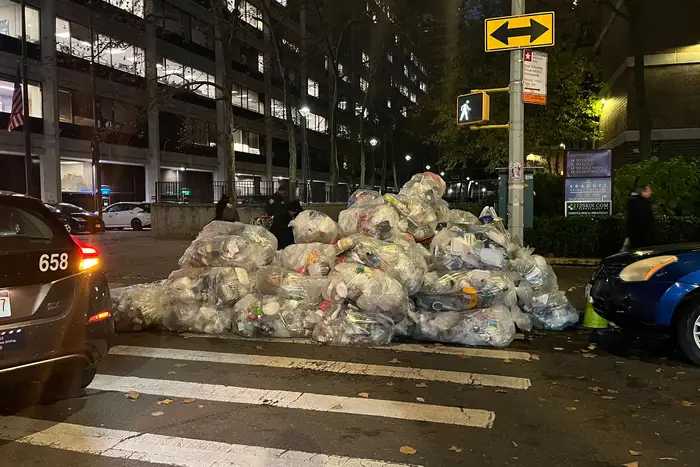
UPDATE: A new report, released on July 15, 2023, has raised serious concerns about New York City’s sanitation plan, urgently calling for the inclusion of recycling in the city’s containerization efforts. The report, published by the Center for Building in North America and the Center for Zero Waste Design, highlights that while the city is making strides under Mayor Eric Adams to secure trash in containers, recycling continues to clutter sidewalks, posing a significant public nuisance.
The sanitation department’s current strategy mandates that all businesses and small residential buildings use secured bins for garbage. However, it neglects the heaps of paper, plastic, and glass recyclables still littering the streets. Clare Miflin, executive director of the Center for Zero Waste Design, emphasized the need for a more comprehensive approach, stating, “When you’re going to do something this big and expensive, I think you need to think bigger.”
Miflin envisions a future where recyclables and compostable waste are also stored in the city’s new Empire Bins, which are gradually being installed in parking spaces across the city. These bins are intended to improve sanitation by removing trash from sidewalks, yet the report argues that this initiative should be expanded to include recycling.
Currently, the sanitation department plans to install these bins in front of every residential building with more than 30 units within the next seven years. Owners of smaller buildings can either request bins or continue to use wheelie bins for collection. Landlords with fewer than 10 units must already use smaller containers for trash disposal.
Sanitation department spokesperson Joshua Goodman defended the current plan, explaining that the focus is on balancing the realities of narrow city streets with the goal of minimizing trash on sidewalks. He noted that the less frequent collection of recycling does not attract pests in the same way as garbage bags do. “For a long time, people either said containerization in New York City would be incredibly easy or they said it would be entirely impossible. Both of those groups were wrong,” he stated. “It is achievable… and requires trade-offs.”
The push to include compost and recycling in the Empire Bins is not without precedent. Pilot programs have successfully installed bins outside school buildings in parts of Brooklyn and Upper Manhattan, featuring separate receptacles for organic waste and recyclables due to the higher volume of compostable waste produced by schools compared to residential buildings.
The Center for Zero Waste Design has consistently challenged the sanitation department’s containerization efforts, arguing they fall short of what is needed for an ambitious waste management strategy. With Zohran Mamdani set to take office soon, there may be an opportunity for these concerns to gain traction. Miflin is part of Mamdani’s transition team, and the mayor-elect has expressed support for the containerization of the city’s recycling.
As the city grapples with its waste management strategy, the call for an urgent reevaluation of recycling practices is louder than ever. Residents and advocates alike await the city’s next move, hoping for a more inclusive approach that addresses both trash and recycling in a holistic manner.
Stay tuned for further updates as this situation develops.