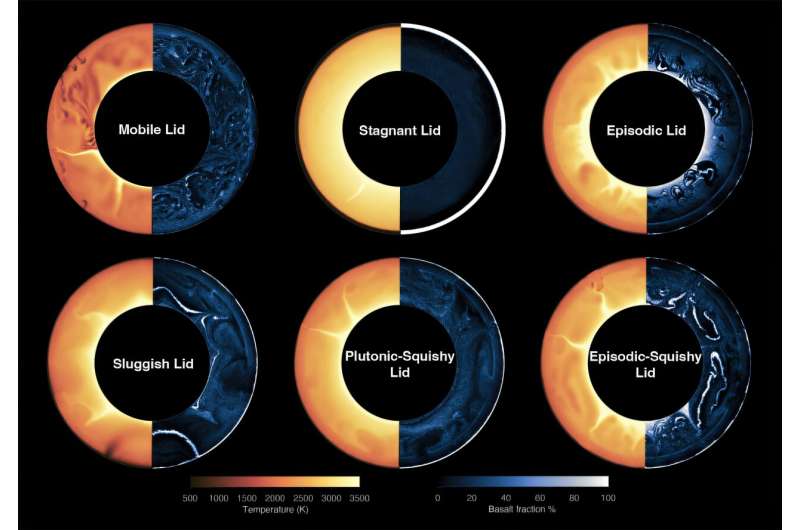
An international team of researchers has made a groundbreaking discovery regarding the tectonic evolution of terrestrial planets, particularly Earth and Venus. The study, published in the journal Nature Communications, introduces six distinct planetary tectonic regimes and highlights a new regime called the “episodic-squishy lid.” This research not only sheds light on the origins of Earth’s plate tectonics but also offers insights into the unique geological characteristics of Venus.
Understanding Tectonic Regimes
Tectonic regimes refer to the large-scale deformation processes that shape a planet’s surface layers. These regimes influence geological activity, internal evolution, magnetic fields, atmospheric composition, and the potential for life. A longstanding question in planetary science has been why Earth showcases active plate tectonics, while Venus, often referred to as Earth’s “sister planet,” exhibits a contrasting geological landscape.
The study identifies six tectonic regimes, including the “mobile lid” seen on Earth and the “stagnant lid” regime characteristic of Mars. On Mars, the surface has remained largely immobile, preserving ancient impact craters. In contrast, Earth’s active plate tectonics, marked by mid-ocean ridges, transform faults, and subduction zones, have contributed to the planet’s stability over millions of years, fostering conditions suitable for life.
Dr. Tianyang Lyu, a postdoctoral fellow at The University of Hong Kong and the first author of the study, explained, “Through statistical analysis of vast amounts of model data, we were able to identify six tectonic regimes for the first time quantitatively. This includes our newly discovered ‘episodic-squishy lid,’ which alternates between modes of activity, offering a fresh perspective on planetary transitions.”
Decoding Planetary Evolution
A significant challenge in assessing a planet’s tectonic evolution has been the “memory effect,” where a planet’s current tectonic state is influenced by its historical conditions. Professor Man Hoi Lee from The University of Hong Kong noted, “Our models reveal that this ‘memory effect’ is not insurmountable. Particularly for Earth, where the lithosphere weakens over time, the transition between tectonic regimes can be surprisingly predictable.”
The research team created a comprehensive diagram outlining the six tectonic regimes under various physical conditions, mapping potential transition pathways as a planet cools. This mapping provides crucial insights into how Earth transitioned to its current tectonic state.
Professor Guochun Zhao, also from The University of Hong Kong and an Academician of the Chinese Academy of Sciences, added, “Geological records suggest that tectonic activity on early Earth aligns with our newly identified regime. As Earth cooled, its lithosphere became more prone to fracturing, leading to the development of plate tectonics. This understanding is key to explaining Earth’s habitability.”
Insights into Venusian Geology
The findings also provide a compelling explanation for the geological features observed on Venus. The study suggests that surface formations, such as the circular “coronae” that span over 1,000 kilometers, align with the “plutonic-squishy lid” or “episodic-squishy lid” regimes. In these scenarios, magmatic intrusions weaken the lithospheric lid, resulting in intermittent tectonic activity influenced primarily by mantle plumes.
Professor Zhong-Hai Li from the University of Chinese Academy of Sciences, a co-author of the study, remarked, “Comparing our model results with geological observations of Venus is exciting. This research offers valuable theoretical references and observational targets for future missions to Venus.”
Implications for Future Research
This research establishes a new framework for understanding planetary tectonic diversity, which will be vital for future explorations of other celestial bodies. Dr. Maxim D Ballmer from University College London, another co-author, emphasized the interconnectedness of mantle convection and magmatic activity. “This allows us to view the long geological history of Earth and the current state of Venus within a unified theoretical framework, providing a crucial basis for the search for potentially habitable Earth analogs and super-Earths outside our solar system.”
The study marks a significant advancement in planetary science, offering new tools and insights that could enhance our understanding of tectonic processes across various planets. As researchers continue to explore these dynamics, the potential for new discoveries in our solar system and beyond remains vast.