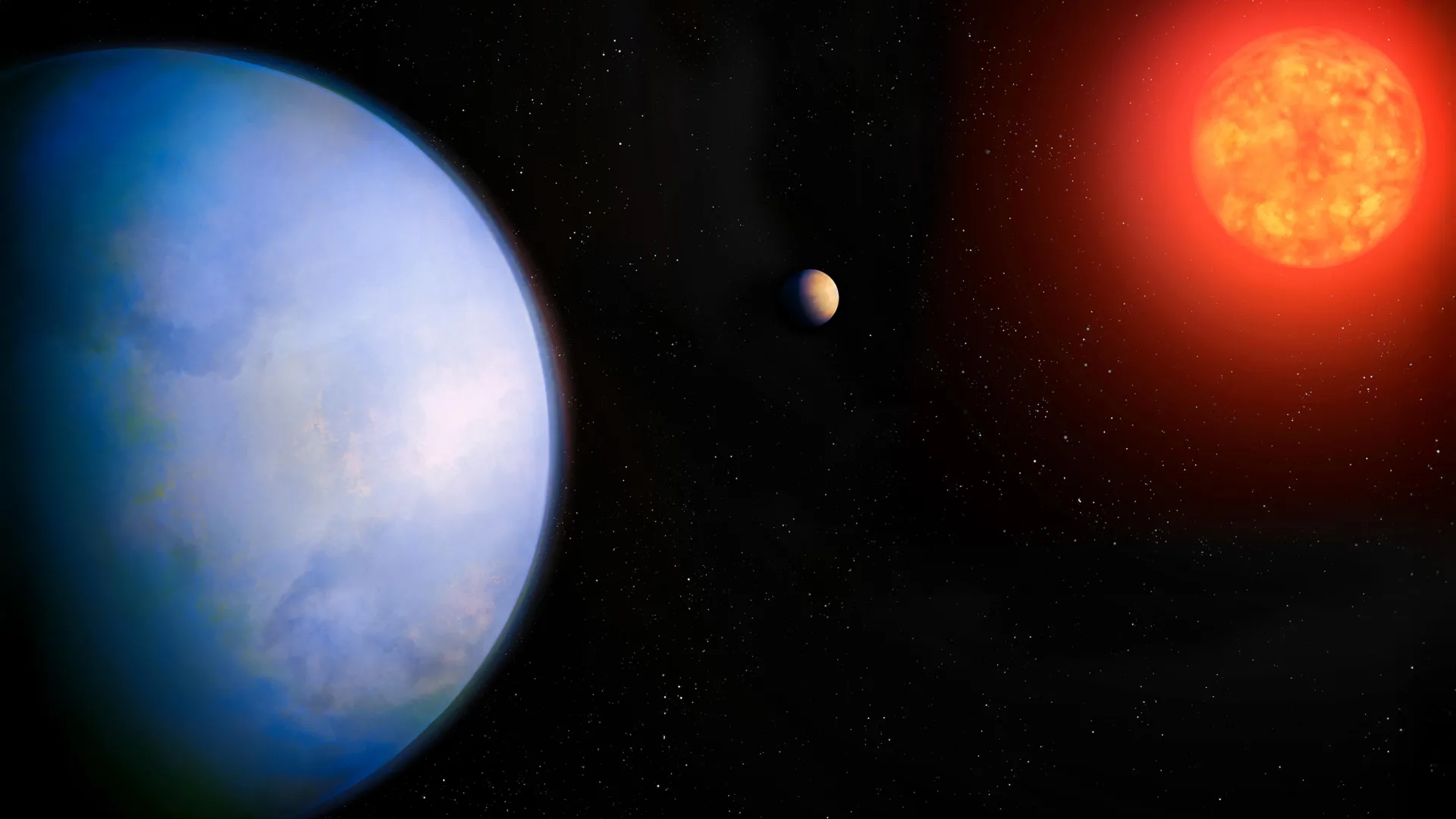
Astronomers at the University of California – Irvine have identified a super-Earth located in the habitable zone of an M-dwarf star, just 18 light-years away from Earth. This discovery positions the newly named planet, GJ 251 c, as a compelling target in the ongoing search for extraterrestrial life due to its potential to support liquid water, a key ingredient for life as we know it.
Researchers published their findings in a paper in The Astronomical Journal, highlighting that GJ 251 c is several times more massive than Earth and exhibits a rocky structure. Its proximity and characteristics make it an attractive candidate for future studies, particularly for direct imaging with advanced telescopes like the Thirty Meter Telescope (TMT), currently under development.
Understanding the Star System
GJ 251 c orbits an M-dwarf star, a type of star common in the Milky Way and known for its significant stellar activity, including starspots and flares. These characteristics can sometimes mimic the signals that astronomers look for when identifying planets, complicating the detection process. Despite these challenges, the planet’s relatively close distance enhances its prospects for detailed observation.
Co-author of the study, Paul Robertson, an associate professor of physics and astronomy at UC Irvine, emphasized the significance of this discovery. “We have found so many exoplanets at this point that discovering a new one is not such a big deal. What makes this especially valuable is that its host star is close by,” he stated.
Advanced Instruments and Techniques
The research team utilized data from two sophisticated instruments, the Habitable-zone Planet Finder and NEID, designed to detect exoplanets by measuring their gravitational influence on their stars. As GJ 251 c orbits its star, it induces slight shifts in the star’s light, known as radial velocity signatures. These subtle signals confirmed the presence of the planet, demonstrating the efficacy of the instruments in overcoming the challenges posed by stellar activity.
Lead author of the study, Corey Beard, a former graduate student from Robertson’s group, noted the importance of the TMT in future observations. “TMT will be the only telescope with sufficient resolution to image exoplanets like this one. It’s just not possible with smaller telescopes,” he explained.
The research team’s computational models reached a robust statistical significance, supporting the classification of GJ 251 c as a viable exoplanet candidate. They advocate for continued investment in next-generation telescopes to confirm the planet’s properties, particularly regarding the presence of water.
Beard and Robertson hope their findings will spur further exploration of GJ 251 c, especially as new observatories such as the TMT near operational status. Collaborators on this important research included scientists from institutions like UCLA and Pennsylvania State University, as well as experts from the Netherlands and the University of Colorado, Boulder.
The research received support from the National Science Foundation grant AST-2108493 for the HPF exoplanet survey, alongside funding from NASA and NSF’s NN-EXPLORE program.
As the search for life beyond Earth continues, GJ 251 c stands out as a prime candidate, drawing attention from the scientific community eager to explore its potential and understand more about our universe.