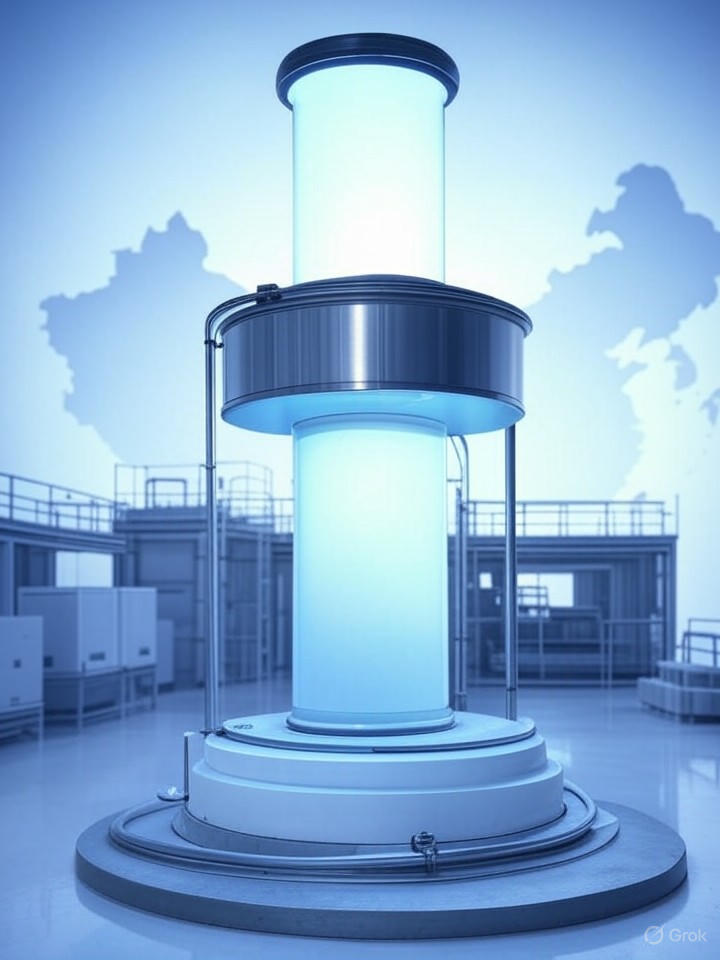
In a significant advancement for nuclear energy, scientists at the Shanghai Institute of Applied Physics, part of the Chinese Academy of Sciences, have successfully achieved the world’s first sustained thorium-to-uranium breeding within a molten salt reactor. This groundbreaking milestone was announced in early November 2025 and marks a pivotal moment for the future of energy production, with implications that could extend far beyond China’s borders.
The experimental TMSR-LF1 reactor, located in Gansu Province, has demonstrated a novel process where thorium-232 absorbs neutrons to be converted into uranium-233, a fissile isotope capable of sustaining nuclear reactions. This innovative approach could lead to a new era of safer and more efficient nuclear power, as thorium presents a more abundant and less hazardous alternative to traditional uranium-based systems.
This achievement has the potential to reshape global energy dynamics, particularly in light of China’s vast thorium reserves, which some estimates suggest could sustain the country’s energy needs for up to 60,000 years. According to the South China Morning Post, this breakthrough could significantly reduce China’s reliance on imported uranium, enhancing its energy security and reducing geopolitical vulnerabilities.
Understanding the Technology Behind Thorium Breeding
The TMSR-LF1 reactor employs a fluoride-based molten salt mixture that facilitates the thorium conversion process. Neutrons produced during fission reactions convert thorium into uranium-233, thereby generating more fuel than is consumed—a key characteristic of breeder reactors. The reactor has now confirmed this conversion, validating the thorium fuel cycle, as reported by World Nuclear News.
Notably, thorium is three to four times more abundant than uranium in the Earth’s crust. Recent discoveries in Inner Mongolia alone could provide energy resources for decades. The safety profile of molten salt reactors is also a significant advantage; they operate at atmospheric pressure, which minimizes the risks associated with containment failure and overheating—a stark contrast to traditional solid-fuel reactors, as seen in historical incidents like Fukushima.
The operational efficiency of the TMSR-LF1 has been enhanced by its ability to perform online refueling, a feature demonstrated earlier in 2025. This capability allows the reactor to maintain continuous operation without shutdowns, supporting higher uptime rates that could exceed 90%, compared to the 60-70% typical of conventional nuclear plants.
Implications for Global Energy Security and Future Prospects
This breakthrough in thorium breeding has profound implications for energy independence, particularly for China, the world’s largest energy consumer. Currently, much of China’s uranium is sourced from Kazakhstan and Australia. The successful implementation of thorium breeding could eliminate this dependence while positioning China as a leader in next-generation nuclear technology.
China’s advancements in this field resonate with historical efforts in thorium research, notably those initiated by Homi J. Bhabha in the 1950s in India. However, China’s state-backed approach, with significant investments since 2011, has enabled it to advance rapidly beyond its competitors. Insiders anticipate the development of a 100 MW demonstrator reactor by 2035, further accelerating the commercialization of this technology.
Moreover, the versatility of thorium reactors may extend to various applications, including nuclear-powered vessels. Recent announcements detail plans for a cargo ship powered by a 200 MW thorium molten salt reactor, which could contribute to decarbonizing the shipping industry, a sector responsible for approximately 3% of global emissions.
While the prospects of thorium technology are promising, experts express concerns over potential proliferation risks associated with uranium-233. However, the thorium fuel cycle produces significantly less plutonium, which could mitigate these concerns.
As China continues to forge ahead with its thorium initiatives, the international community, particularly Western nations, must take heed. Current efforts in the U.S. and Europe are hindered by regulatory challenges and public apprehension following nuclear disasters. In contrast, China’s significant investments and strategic focus may reshape the landscape of nuclear energy globally.
Looking forward, China aims to scale from a 2 MWt experimental unit to commercial reactors capable of gigawatt-scale output. Challenges such as corrosion in molten salts and efficient fuel reprocessing must be addressed, with plans for a 373 MW demonstrator by 2030 already in the pipeline. Successful integration of thorium with renewable energy sources could provide stable power solutions for emerging technologies, including AI data centers.
As excitement builds around this pivotal development, the world watches closely. The advancements in thorium breeding not only signify a technical victory but also a strategic shift towards sustainable energy dominance, promising a cleaner and more secure energy future. With thorium’s potential to power nations for millennia, the quiet revolution taking place in the Gobi Desert could soon resonate on a global scale.