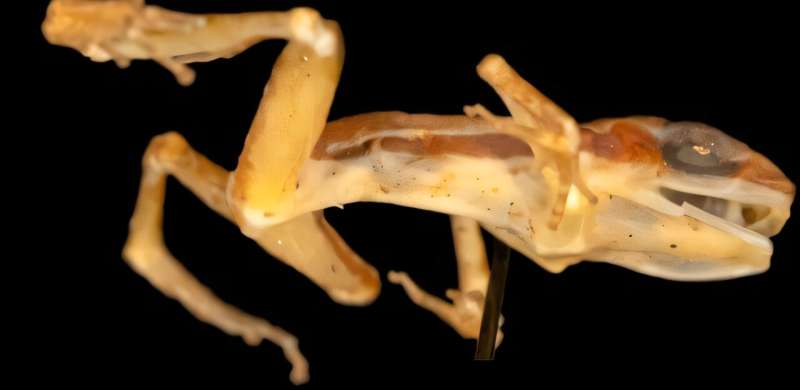
A newly identified species of rocket frog, named Dryadobates erythropus, has been classified as likely extinct based on a single specimen collected in 1963. Researchers from the University of São Paulo (USP) and the Smithsonian Institution in the United States made this discovery, which highlights the loss of biodiversity in urban areas like Curitiba, Brazil.
The study, published in the journal Zootaxa, reveals that the only known specimen of this frog is housed at the Smithsonian’s National Museum of Natural History. Collected by American herpetologist Doris M. Cochran, the specimen is approximately 14 millimeters long and is described as quite dried out. Due to the absence of other specimens found in the wild, the species is considered “probably extinct.”
The habitat where D. erythropus once thrived has largely been destroyed, as urban development has replaced the wetlands and open fields that characterized the area in the 1960s. According to Taran Grant, a professor at USP and lead author of the study, extensive surveys conducted in São Paulo and Paraná over the past six decades have yielded no additional finds.
Dryadobates is a genus that includes at least 13 species, of which four have already been declared extinct. The name “Dryadobates” is inspired by a nymph from Greek mythology, while “erythropus” refers to the “red foot,” a nickname associated with rural workers in northern Paraná.
To pinpoint the exact location where Cochran collected the frog, Grant delved into historical records, including Cochran’s travel diary from her trip to Brazil. This effort revealed that the frog was captured in an area described as “a large field full of anthills and cow-chewed bushes,” which is now significantly altered due to urbanization.
The specimen’s geographical position is notable, as it is located about 550 kilometers south of the closest known living species in the genus, D. olfersioides, which is also extinct. This distance suggests the possibility of undiscovered frog populations that existed between these two locations.
In their research, Grant and his colleagues attempted to extract historical DNA from the frog specimen, but the results were unsuccessful. The specimen’s condition indicated it likely deteriorated before preservation, with contamination from human DNA and bacteria complicating the analysis. “We were unable to find sufficient genetic material,” Grant noted, emphasizing the challenges posed by the specimen’s state.
Despite the absence of genetic data, the researchers identified morphological features that distinguish the frog from its relatives, allowing classification as a new species. Grant asserts that this research underscores the importance of conserving natural habitats and paying homage to the contributions of pioneering scientists like Cochran and entomologist Doris H. Blake, who played essential roles in uncovering the biodiversity of their time.
The identification of D. erythropus serves as a poignant reminder of the biodiversity that existed in areas now transformed by human activity. As Grant concluded, “If it weren’t for them, we wouldn’t know that we once had this species.”
This study not only enriches scientific understanding of the historical distribution of frog species but also calls for continued efforts to document and protect remaining natural ecosystems.