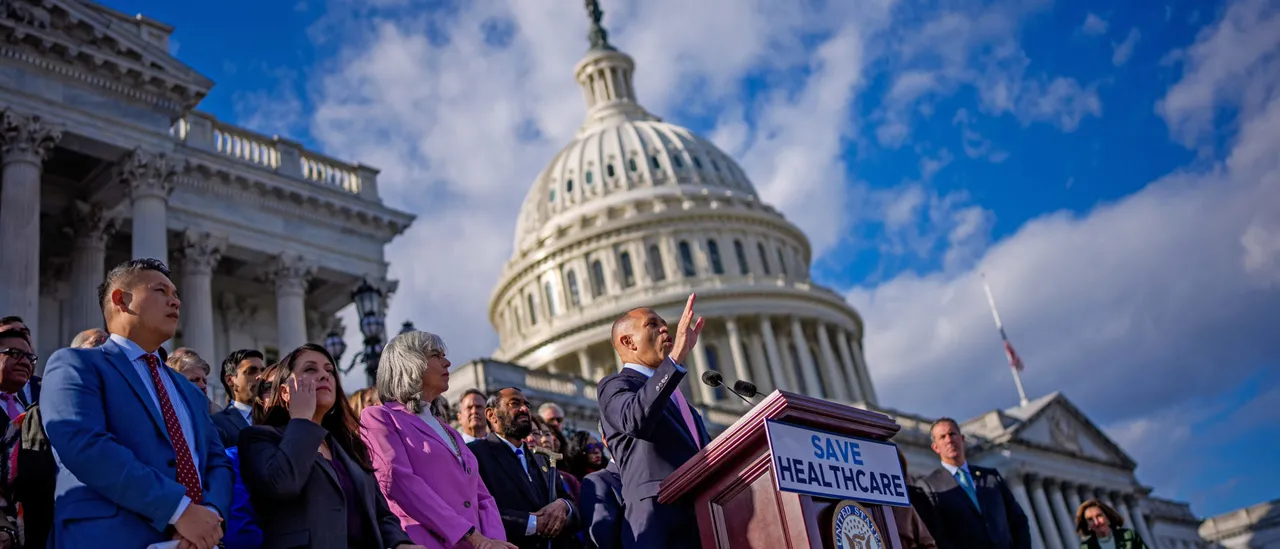
A recent poll reveals that the Democratic Party holds a significant 14-point lead over the Republican Party for the 2026 congressional elections. The NPR/PBS News/Marist poll, published on November 15, indicates that 55% of registered voters would choose a Democratic candidate in their district if elections were held today. In contrast, 41% express support for Republican candidates, while only 3% would back candidates from other parties.
This poll marks a notable shift in voter sentiment, as it is the first time in over three years that Democrats have gained a substantial advantage in the congressional generic ballot. Among independent voters, the Democrats lead by a remarkable 33 points, highlighting their appeal beyond traditional party lines.
Despite this electoral advantage, voter confidence in the Democratic Party remains low. Only 29% of registered voters report having a “great deal” or “quite a lot” of confidence in the party. A staggering 71% expressed “not very much” or “no confidence at all.” In comparison, 35% of voters have a favorable view of the Republican Party, while 65% lack confidence in them.
Low Confidence in Congress Overall
The poll also explored broader sentiments towards Congress as a whole. Just 20% of respondents indicated they had a “great deal” or “quite a lot” of confidence in the legislative branch, while 80% expressed significant skepticism.
Recent electoral victories for Democrats in key states such as New York City, New Jersey, and Virginia on November 4, 2025, have been highlighted by Democratic National Committee (DNC) Chairman Ken Martin. In a post on social media, Martin referred to these wins as a testament to the party’s potential when they unify and engage with voters effectively.
Despite the Democratic Party’s recent successes, House Republicans have been boasting a fundraising advantage as they prepare for the 2026 elections. The National Republican Congressional Committee (NRCC) has expressed confidence in maintaining control of the House of Representatives, as reported by the Daily Caller News Foundation.
The NPR/PBS News/Marist poll surveyed 1,443 U.S. adults from November 10-13. The methodology included live interviews, text messages, and online responses, yielding a margin of error of plus or minus 3.0 percentage points. This comprehensive approach aims to capture a representative snapshot of voter sentiment leading into the crucial midterm elections.
As the political landscape evolves, both parties will need to address the trust deficit among voters while strategizing to mobilize support for the upcoming elections.