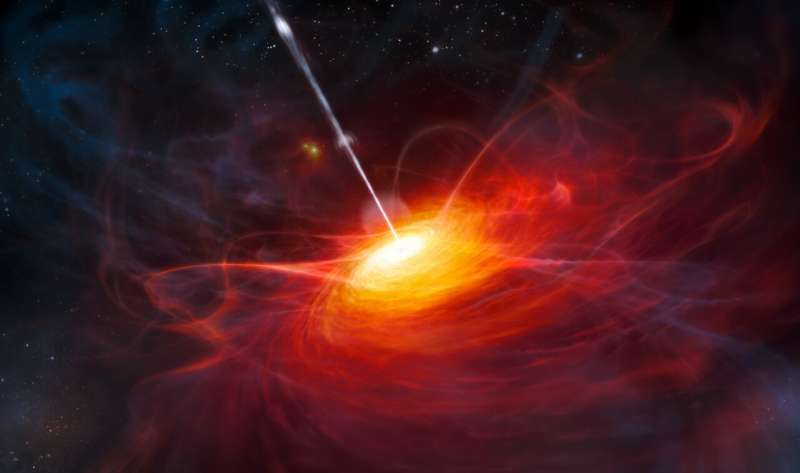
An international team of astronomers has identified a distant quasar, designated as ID830, as the most X-ray luminous radio-loud quasar known to date. This significant finding is the result of observations conducted using the Spektr-RG spacecraft and various ground-based telescopes. The results were published on November 7, 2025, on the pre-print server arXiv.
Quasars, or quasi-stellar objects, represent active galactic nuclei powered by supermassive black holes (SMBHs). These celestial phenomena can emit electromagnetic radiation across a wide array of wavelengths, including radio, infrared, visible, ultraviolet, and X-ray. ID830, or eFEDS J084222.9+0010000, is particularly notable as it has a redshift of 3.43, indicating its significant distance from Earth. Its bolometric luminosity reaches approximately one quindecillion erg/s, suggesting the presence of either an exceptionally massive SMBH near the upper mass limit of 10 billion solar masses or an SMBH undergoing super-Eddington accretion.
Led by Sakiko Obuchi from Waseda University in Tokyo, the research team undertook a comprehensive multiwavelength study of ID830. By integrating data from various sources, including eROSITA X-ray spectroscopy, SDSS, and extensive radio data from LOFAR, GMRT, FIRST, ASKAP, and VLASS, they uncovered that ID830 exemplifies a rare case of a super-Eddington, radio-loud quasar exhibiting an extreme X-ray excess.
Notably, the study revealed that ID830 possesses an X-ray luminosity of approximately 0.01 quindecillion erg/s, making it one of the most X-ray luminous radio-loud quasars detected thus far. Its measured bolometric luminosity is around 0.076 quindecillion erg/s, resulting in an Eddington ratio of 1.4, which confirms the occurrence of super-Eddington accretion. The research also found that ID830 demonstrates moderate reddening, estimated at 0.39 mag, and the mass of the associated supermassive black hole is around 440 million solar masses.
The study further identified that ID830 exhibits a high ultraviolet-to-X-ray luminosity ratio of -1.2, which is elevated when compared to other quasars and early active galactic nuclei known as little red dots (LRDs) in the super-Eddington phase. This suggests that ID830 is in a transitional phase, where the corona and jet are energized simultaneously following an accretion burst.
The authors conclude that ID830 may represent a post-burst super-Eddington quasar that bridges the gap between sub-Eddington quasars and the newly identified X-ray weak, rapidly accreting ‘little red dots’ that have been characterized using the James Webb Space Telescope (JWST).
This groundbreaking research highlights the complexities of quasars and their associated supermassive black holes, contributing valuable insights into the nature of these enigmatic celestial objects.