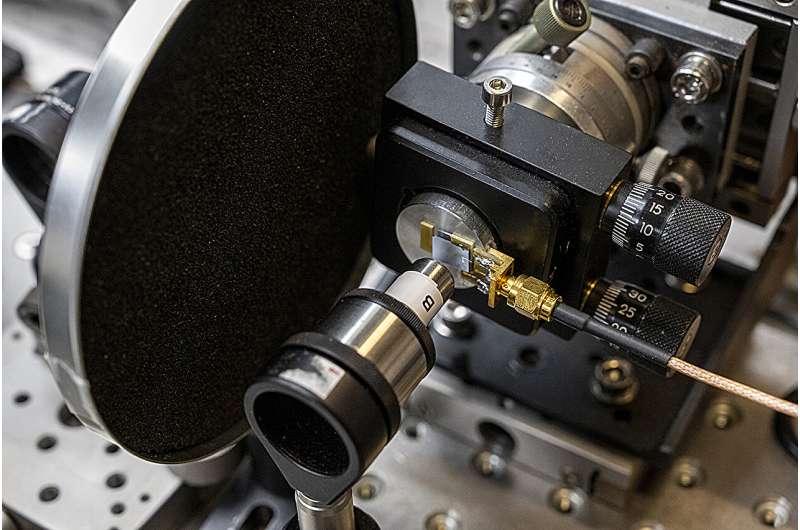
Researchers at Leiden University have conducted a groundbreaking experiment that draws parallels between sound and light at a microscopic scale. This study, published on November 13, 2025, in the journal Optics Letters, marks the first time the principles of Thomas Young‘s double-slit experiment, originally performed with light in 1801, have been applied to sound waves.
The team, led by Ph.D. student Thomas Steenbergen, discovered that sound waves exhibit similar behaviors to light waves, but also demonstrate distinct differences. Steenbergen stated, “We saw that sound waves in materials behave in the same way as light, but also slightly differently. With a mathematical model, we can now explain and predict this behavior.”
Understanding Sound Waves at a Microscopic Level
Young’s double-slit experiment revealed that light can behave both as a particle and a wave. For this new study, Steenbergen and colleague Löffler sought to explore how sound waves behave in a similar setup. They built on a project initiated by undergraduate student Krystian Czerniak, aiming to understand sound dynamics at the smallest scale.
The researchers employed gigahertz sound waves, which vibrate at a frequency of one billion times per second—far beyond human hearing. In their experiment, sound waves were directed at a small piece of semiconductor material known as gallium arsenide, commonly used in electronics. They created two tiny grooves (slits) in the material using an ion beam.
Steenbergen explained, “We then measure the sound with an extremely precise optical scanner. This device can measure sound literally everywhere, including in and in front of the slits. We can measure the height of the sound waves with picometer precision—that’s one millionth of a micrometer.”
Interference Patterns and Their Implications
As anticipated, the experiment produced an interference pattern similar to that observed with light. This pattern clearly demonstrated areas where sound waves reinforce each other and where they cancel out. Steenbergen noted, “But if you look closely, you also see that the pattern is not completely symmetrical. Sound waves don’t move the same way in all directions. The speed of the waves depends on the angle at which they pass through the material.”
By developing a mathematical model, the research team was able to explain these differences in behavior and make accurate predictions.
This research not only enhances the understanding of sound waves but also has practical implications. Gigahertz sound waves are already prevalent in telecommunications, particularly in 5G devices and micro-electronic sensors. The insights gained from this study could lead to advancements in these technologies and contribute to the emerging field of quantum acoustics, where sound waves are used to transmit information at the quantum level.
In summary, a centuries-old experiment is paving the way for new discoveries in sound and light interactions, illustrating how foundational principles of physics continue to influence modern technology and scientific understanding.