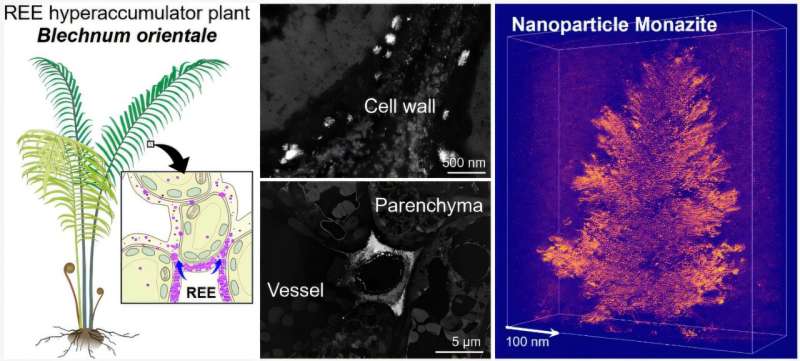
Scientists in South China have made a significant discovery involving a fern that naturally forms tiny crystals containing rare earth elements (REEs). This finding, published on November 13, 2025, in the journal Environmental Science & Technology, provides a potential breakthrough for sustainable mineral extraction through a process known as phytomining.
Rare earth elements, comprising a group of 17 metals, are essential for various technologies, including wind turbines, electric vehicle batteries, smartphones, and medical imaging devices. Despite their name, these elements are not as abundant as one might think, typically found at low concentrations in the Earth’s crust. Traditional methods of extracting REEs are often costly and environmentally damaging, involving extensive mining operations that use harsh chemicals and lead to significant land degradation.
Researchers studied the fern known as Blechnum orientale, which has been recognized as a hyperaccumulator capable of thriving in high-metal environments. Previous studies had established its ability to absorb metals through its roots; however, the specific chemical form of REEs within the plant was unknown prior to this research. Understanding this aspect is crucial for developing efficient extraction methods.
Using advanced imaging technology and chemical analysis, the team discovered that the fern produces nanoscale crystals of a mineral called monazite within its tissues. These crystals were primarily found in the cell walls and the spaces between cells. Monazite is one of the main sources of rare earth elements in geological deposits around the globe. The researchers noted that the crystals exhibit a complex, self-organizing pattern, reminiscent of a microscopic “chemical garden.”
This remarkable finding marks the first instance of scientists observing a living plant create a crystal containing rare earth elements. While it may not mean that people will be cultivating gardens specifically for REEs anytime soon, the research underscores the feasibility of phytomining as a sustainable alternative to conventional mining practices.
Liuqing He, one of the study’s authors, stated, “Our findings uncover a previously unrecognized, plant-mediated pathway for critical mineral formation in a supergene environment.” He added that this discovery not only enhances our understanding of REE enrichment during chemical and biological weathering but also opens new avenues for the direct recovery of valuable REE materials.
The implications of this research could be far-reaching, suggesting that plants like Blechnum orientale could one day offer a less destructive and more cost-effective means of extracting rare earth elements, which are increasingly vital in today’s technology-driven world. As the demand for renewable energy and advanced electronics continues to grow, the need for sustainable mining solutions becomes more pressing.
This discovery contributes to ongoing efforts to find environmentally friendly methods of mineral extraction and highlights the potential role of plants in addressing global resource challenges. The findings pave the way for further research into other plants that may possess similar capabilities, potentially reshaping the landscape of mineral procurement in the future.
The article was authored by Paul Arnold, edited by Lisa Lock, and reviewed by Robert Egan, ensuring a high standard of journalistic integrity and accuracy.