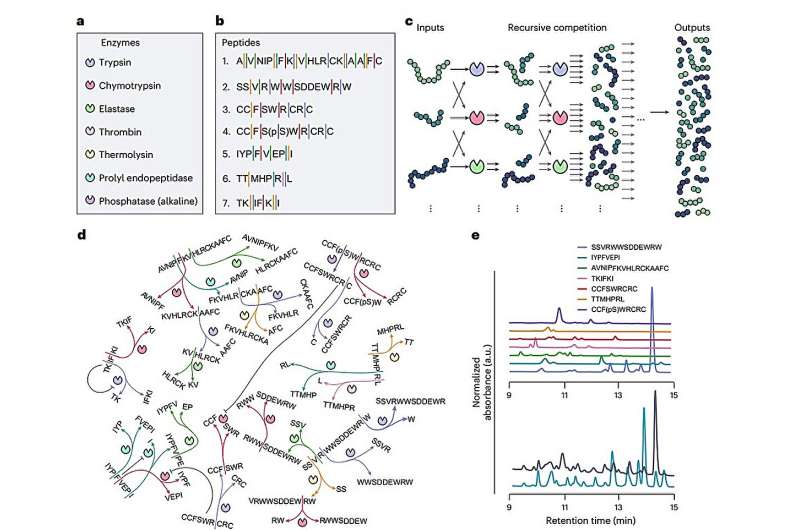
A team of researchers from the Netherlands and Australia has developed a groundbreaking chemical network capable of decision-making based on external environmental conditions. This innovative system, detailed in a study published on November 12, 2025, in Nature Chemistry, represents a significant leap in mimicking biological processes through a synthetic network of competing peptides and enzymes.
The research focuses on a recursive enzymatic competition network (ERN) that allows peptides to compete for a unique set of enzymes known as proteases. This competition creates a dynamic chemical environment that not only adapts to various stimuli but also reorganizes itself in response to changing conditions. The network demonstrates the ability to accurately sense temperature variations within the range of 25–55°C at a precision of approximately 1.3°C, showcasing its potential for complex information processing similar to biological systems.
Emulating Biological Complexity
In biological systems, organisms continuously gather information from their surroundings, detecting factors such as nutrients, temperature, and acidity. These processes typically operate within a complex network of interactions that drive efficient responses. Researchers have long sought to replicate this behavior in synthetic systems. Previous attempts have employed network motifs—repetitive patterns found in nature—to design chemical networks. However, they often fell short of capturing the full intricacy of biological information processing.
The new research leverages recursive interactions within the ERN, allowing the network to generate diverse chemical products from minimal starting inputs. By constructing a system with seven enzymes and seven peptides, the researchers created a competitive landscape where peptides undergo continual cleavage and recombination. This ever-changing mixture leads to a complex network of enzymatic reactions, producing a wide variety of chemical fragments that vary significantly according to initial input conditions, including peptide concentration and environmental factors such as temperature or pH.
Real-Time Data Processing
Real-time measurements of the chemical fragments are conducted using a mass spectrometer. The data collected is processed by a linear readout layer algorithm, which interprets the fragment patterns and translates them into decisions or predictions. This capability enables the network to perform dynamic sensing tasks, such as detecting temperature fluctuations and identifying time-based or light-pulse periodicity changes.
The researchers believe that the functionalities exhibited by the ERN could pave the way for advanced biosensors and materials with practical applications in fields such as health care and technology. The findings suggest that this synthetic network could enhance our ability to create smarter, more adaptable systems capable of responding to real-world challenges.
As the field of synthetic biology continues to evolve, this innovative work exemplifies how researchers are bridging the gap between chemical systems and biological intelligence. The implications of such advancements hold promise for a range of applications, potentially transforming various industries and enhancing our understanding of complex biological processes.
For further reading, refer to the original study by Souvik Ghosh et al. in Nature Chemistry (2025), DOI: 10.1038/s41557-025-01981-y.