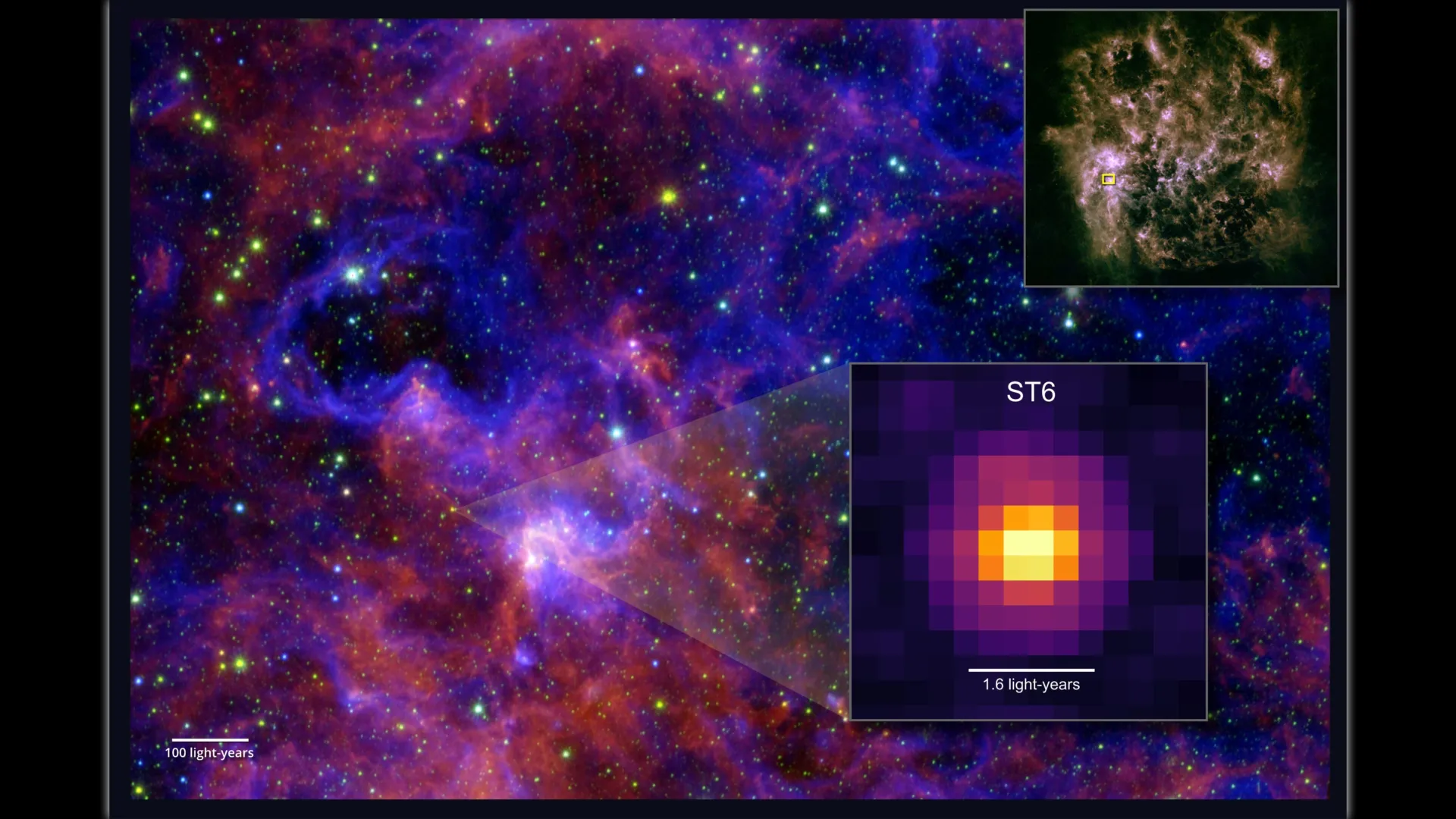
URGENT UPDATE: Astronomers using NASA’s James Webb Space Telescope (JWST) have made a groundbreaking discovery, finding complex organic molecules frozen in ice around a young star in the Large Magellanic Cloud, just 160,000 light-years from Earth. This includes the first-ever detection of acetic acid beyond the Milky Way, a finding that could reshape our understanding of the origins of life in space.
The study, led by Marta Sewilo from the University of Maryland, was published on October 20, 2025, in the Astrophysical Journal Letters. This remarkable research reveals that life’s essential ingredients may have formed much earlier and in a variety of cosmic environments than previously believed.
Using the JWST’s advanced Mid-Infrared Instrument (MIRI), the team identified five carbon-based compounds in the icy surroundings of the protostar known as ST6. These compounds include methanol, ethanol, methyl formate, acetaldehyde, and for the first time, acetic acid detected in space ice. The detection of these molecules marks a significant advancement in understanding how complex organic chemistry operates in different cosmic settings.
“It’s all thanks to JWST’s exceptional sensitivity combined with high angular resolution that we’re able to detect these faint spectral features associated with ices around such a distant protostar,” Sewilo stated. The previous record for complex organic molecule detection in ice was held by methanol within our own galaxy, making this new finding particularly significant.
The implications of this discovery are profound. The Large Magellanic Cloud is a low-metallicity environment, meaning it has a significantly lower abundance of heavy elements compared to our solar system. This suggests that the ingredients necessary for life could form in harsher cosmic conditions that resemble those found in the early universe.
“What we learn in the Large Magellanic Cloud, we can apply to understanding these more distant galaxies from when the universe was much younger,” Sewilo explained. The harsh conditions present in this galaxy provide a unique laboratory for studying the formation of life’s building blocks.
The presence of these complex organic molecules supports theories that life’s ingredients may have formed earlier than previously thought. Although this discovery does not confirm life elsewhere, it demonstrates that organic compounds can withstand the intense conditions of planetary formation, potentially paving the way for life in the universe.
Moving forward, Sewilo and her team plan to expand their research by investigating additional protostars in the Large and Small Magellanic Clouds. “We need larger samples from both to confirm our initial results that indicate differences in complex organic molecule abundances between these two galaxies,” said Sewilo.
This urgent discovery opens new avenues for research and could significantly enhance our understanding of how life could emerge in the cosmos. As the search for extraterrestrial life continues, findings like these reinforce the idea that the building blocks of life are more widespread across the universe than ever imagined.
Stay tuned for more updates on this developing story as scientists delve deeper into the mysteries of the universe.