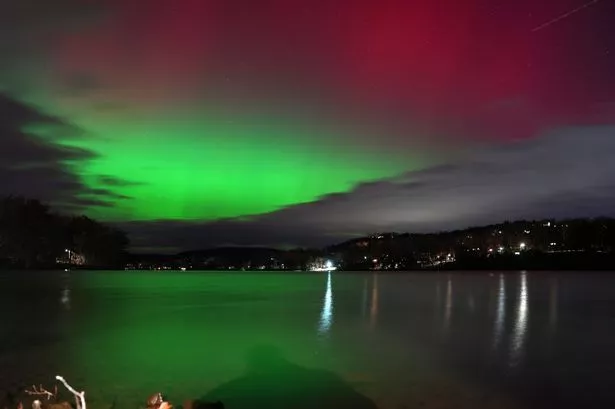
UPDATE: The Northern Lights, also known as the Aurora Borealis, lit up the night sky for New Jersey residents on November 11, thrilling skywatchers and photographers with an extraordinary display. Following a powerful geomagnetic storm, bright bands of purple and green were spotted as far south as southern New Jersey and are expected to continue tonight, November 12.
Residents in Cape May County, Metuchen, and along the Jersey Shore reported seeing vibrant glows shimmering on the horizon, marking one of the most vivid auroral displays in recent memory. The spectacle resulted from a massive coronal mass ejection (CME) from the sun, which was confirmed by the NOAA Space Weather Prediction Center as a G4 (severe) geomagnetic storm.
The solar eruption originated from sunspot region 4274 and ranked as the sixth strongest solar flare of the current cycle. The NOAA warns that this geomagnetic storm could disrupt satellites, navigation systems, and power infrastructure, emphasizing the storm’s potential impact on technology while also providing a breathtaking sight for millions.
As the charged particles from the CME collided with Earth’s magnetic field, they produced dazzling lights that stretched across much of the northern United States and parts of Europe. In New Jersey, photographers captured brilliant displays from Reeds Beach along the Delaware Bay, while faint hues were visible over Metuchen.
More excitement is on the horizon. NOAA predicts that the Aurora Borealis “may become visible over much of the northern half of the country, and maybe as far south as Alabama to northern California.” This means that residents in states including Arkansas, Nevada, and potentially northern California could witness this celestial phenomenon.
The best viewing times for the aurora are around midnight, and it is crucial to find locations with minimal light pollution for optimal visibility. With a G4 storm alert in effect, skywatchers are advised to prepare for another night of incredible views.
Looking ahead, NOAA has issued a storm watch schedule indicating a G2 (moderate) storm for November 11, a G4 (severe) storm for November 12, and a G3 (strong) storm for November 13. Experts highlight that as the current solar cycle approaches its peak in 2025–2026, similar light shows and potential space weather impacts may become increasingly common.
With the night sky expected to dazzle once again, residents are eager to seize the chance to witness this natural wonder. The Aurora Borealis serves as a reminder of the beauty of our universe, and many are sharing their experiences on social media, capturing the magic of the moment. Don’t miss out—head outside tonight for another chance to see the Northern Lights!