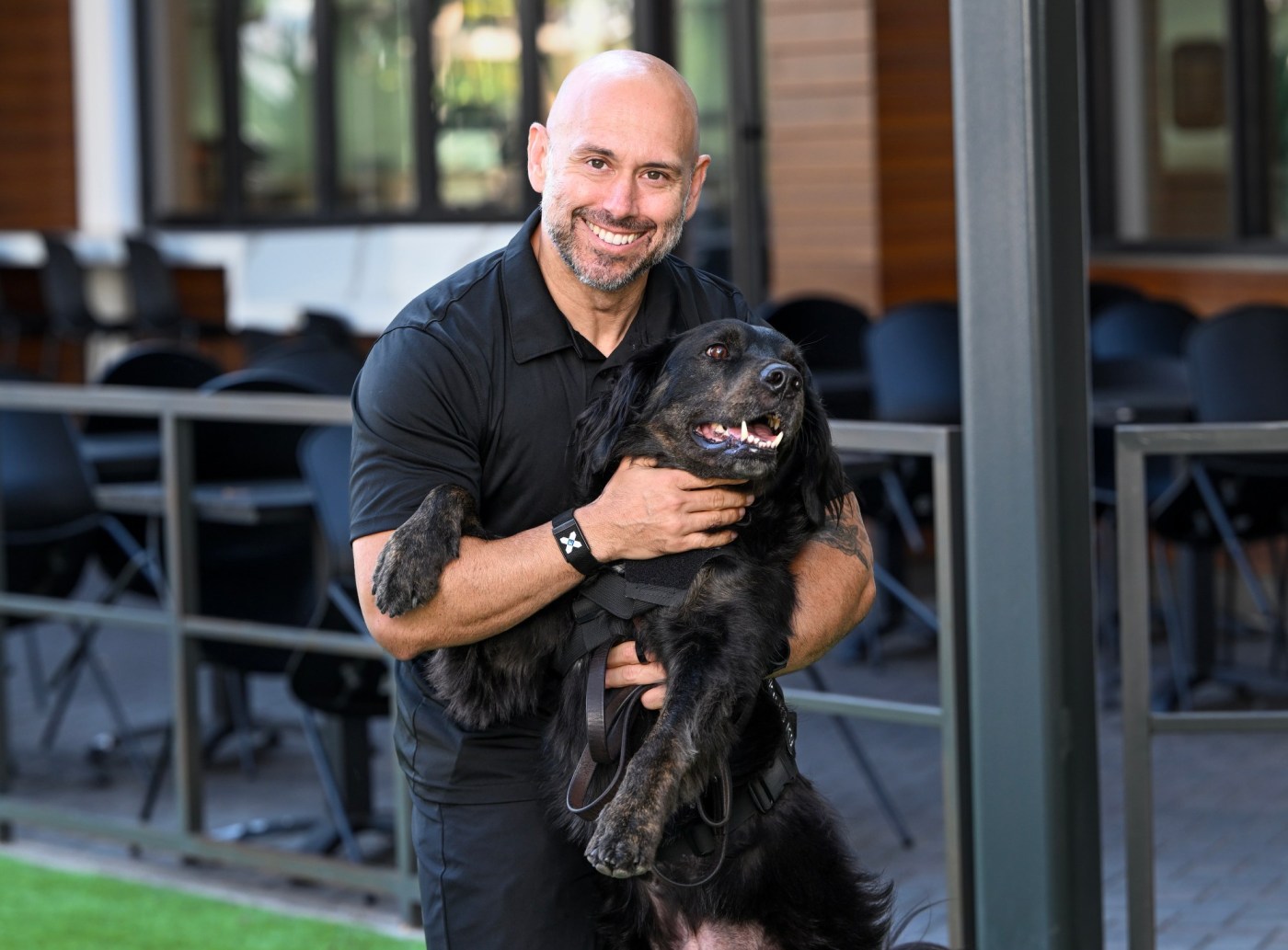
Veterans are increasingly turning to service dogs as a vital resource in their fight against Post-Traumatic Stress Disorder (PTSD). One poignant example is Joe Moreno, a Navy veteran who struggled with severe anxiety after returning from deployment in Iraq. Following a distressing episode in a mall parking lot, Moreno sought help, ultimately leading to a diagnosis of PTSD and the companionship of Eagle, a four-year-old retriever mix service dog.
Moreno, who served in the Navy until 2016, described his experience of living in a world that felt foreign and threatening. “I was always looking over my shoulder and on high alert,” he explained, noting that he had developed coping mechanisms that masked his inner turmoil. Despite his active lifestyle, including competitive sports like Ironman races, he felt overwhelmed and unable to cope with daily life.
After years of struggle, Moreno reached out to the Veterans Administration and received a diagnosis of PTSD. He credits Eagle with transforming his life. “Before Eagle, PTSD had me in survival mode 24/7 just trying to get through another day. Eagle gave me my life back,” he said, emphasizing how the dog has become a source of comfort and stability.
The impact of service dogs on veterans is supported by research. According to the VA, of the 5.8 million veterans served in fiscal year 2024, approximately 14% of men and 24% of women received PTSD diagnoses. Alarmingly, an average of 20 veterans take their own lives each day. Studies indicate that service dogs can significantly reduce suicidal thoughts and reliance on medication.
In recent years, the surge of nonprofit organizations, such as K9s For Warriors, has focused on pairing service dogs with veterans. This particular organization has rescued around 2,000 dogs since its inception in 2011 and aims to provide veterans with life-changing companions. Moreno’s journey began with K9s For Warriors, where he trained with Eagle after the dog was rescued and trained for eight months.
The bond between Moreno and Eagle blossomed during their training, and Moreno felt an emotional connection that no medication had provided. “It was like I finally found what I was looking for that no medication could ever fill,” he said.
Research led by Maggie O’Haire, a psychologist at the University of Arizona, is exploring the effects of therapy dogs on veterans. The recently completed 2024 study, funded by the National Institutes of Health, involved a large-scale clinical trial comparing veterans with and without service dogs. The results demonstrated that those paired with service dogs had a 66% lower likelihood of maintaining a clinical PTSD diagnosis, along with improved outcomes in anxiety and depression.
O’Haire noted, “Doctors, policymakers, and funders need science-based information to inform their recommendations and decisions. We’re excited to share the strongest evidence to date supporting service dog partnership for veterans with PTSD.”
The growing interest in service dogs has led to increased waitlists for many programs. The costs associated with training and raising these dogs can reach up to $25,000, prompting organizations to seek funding to maintain low or no costs for veterans.
Another veteran, Eddie Montoya, a councilman in Rialto, credits his service dog, Sly, with helping him reclaim his life after battling alcoholism and PTSD. After serving 17 years in the Army, Montoya was encouraged by his wife, a therapist, to seek out a service dog. He found Working Dogs for Warriors, where he learned to train his own dog, fostering a sense of community with other veterans.
Montoya’s participation in the program not only aided his recovery but also prompted him to establish the Brotherhood Bridge Foundation, a nonprofit dedicated to supporting fellow veterans. “I give it all to my dog; it wouldn’t have happened without my dog giving me purpose,” he remarked, underscoring the profound impact that service dogs can have on mental health and social reintegration.
With ongoing research and advocacy, veterans like Moreno and Montoya are leading the charge for greater recognition of the healing power of service dogs. The hope is that as awareness grows, more veterans will have access to these life-enhancing companions, allowing them to regain control over their lives and destinies.