In a groundbreaking study published in Nature Physics on November 10, 2025, researchers from the University of California, Berkeley, have made the first experimental observation of a novel phase of matter known as the time rondeau crystal. This newly identified state features a unique coexistence of long-range temporal order with short-term disorder, a significant advancement in the field of quantum physics.
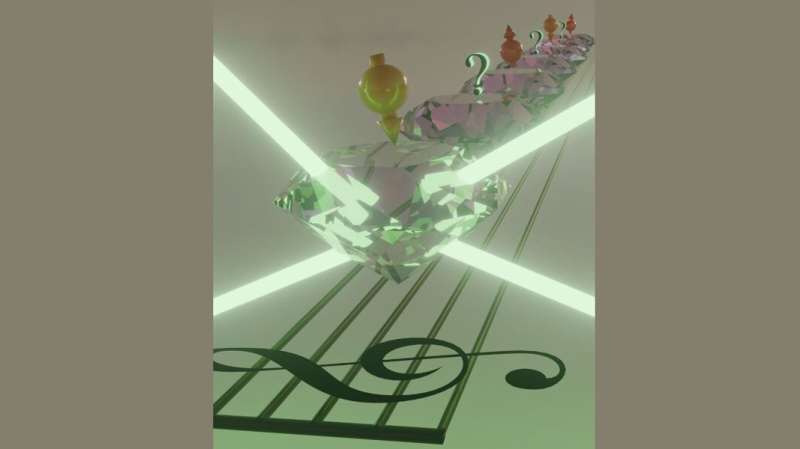
The term “rondeau” is borrowed from a classical musical form characterized by a repeating theme interspersed with contrasting variations. This analogy highlights the crystal’s ability to exhibit perfectly periodic behavior at designated measurement times, while allowing random fluctuations to occur between those intervals. According to Leo Moon, a third-year Ph.D. student in Applied Science and Technology at UC Berkeley and co-author of the study, the research explores the intriguing parallels between order and variation in nature and the arts.
Unveiling a New Phase of Matter
To create the time rondeau crystal, the researchers utilized carbon-13 nuclear spins within a diamond matrix, leveraging a quantum simulator that operated at room temperature. The system consisted of nuclear spins randomly positioned and interacting through long-range dipole-dipole couplings. Initial hyperpolarization of the carbon-13 nuclear spins was achieved using nitrogen-vacancy (NV) centers in the diamond, which are defects where a nitrogen atom is adjacent to an empty lattice site. This process, enhanced by laser illumination, increased the nuclear spin polarization by nearly 1,000-fold above its thermal equilibrium value.
Following this enhancement, the team applied complex microwave pulse sequences that combined protective “spin-locking” pulses with carefully timed polarization-flipping pulses. This structured pattern resulted in the emergence of rondeau order. Moon emphasized the advantages of using diamond as a medium, noting its stability and resistance to environmental changes, which are crucial for conducting experiments involving exotic temporal phases.
Observing Temporal Order and Disorder
The researchers implemented what they termed random multipolar drives (RMD), allowing systematic control over the randomness in their experimental setup. During the drive cycle, the nuclear spins exhibited deterministic polarization flipping at regular intervals, showcasing periodic behavior typical of time crystals. In contrast, the spins fluctuated randomly between these measurements, embodying the hallmark of rondeau order.
This phenomenon was observed to persist for over 170 periods, lasting more than four seconds. The use of discrete Fourier transforms provided evidence for this new phase. Unlike traditional discrete time crystals, which display a single sharp peak in their frequency spectrum, the time rondeau crystal showed a smooth, continuous distribution across all frequencies. Moon referred to this as the “smoking gun” signature that confirms the coexistence of temporal order and disorder.
The team successfully manipulated the system’s behavior by varying drive parameters, creating an extensive phase diagram of the stability of rondeau order. They demonstrated that the lifetime of this order could be tuned through adjustments to the drive period and pulse imperfections.
Additionally, the researchers illustrated that information could be encoded within the temporal disorder. By designing specific sequences of drive pulses, they managed to store over 190 characters of information in the micromotion dynamics of the nuclear spins, representing the title of their paper. This innovative approach suggests that information can be preserved in time rather than space, akin to the relationship between ordered ice and disordered water.
Looking ahead, Moon noted the potential applications of this research in developing quantum sensors that could leverage the tunable disorder within these systems. The work significantly broadens the exploration of non-equilibrium temporal order, surpassing conventional time crystals.
The team also achieved related breakthroughs using deterministic aperiodic drives, successfully realizing time aperiodic crystals and time quasicrystals alongside the rondeau order. Future endeavors will involve exploring alternative materials, such as pentacene-doped molecular crystals, which may enhance sensitivity in these experiments.
As this research continues to unfold, the implications for quantum technology and information storage are profound, indicating a new frontier in the study of complex quantum systems.