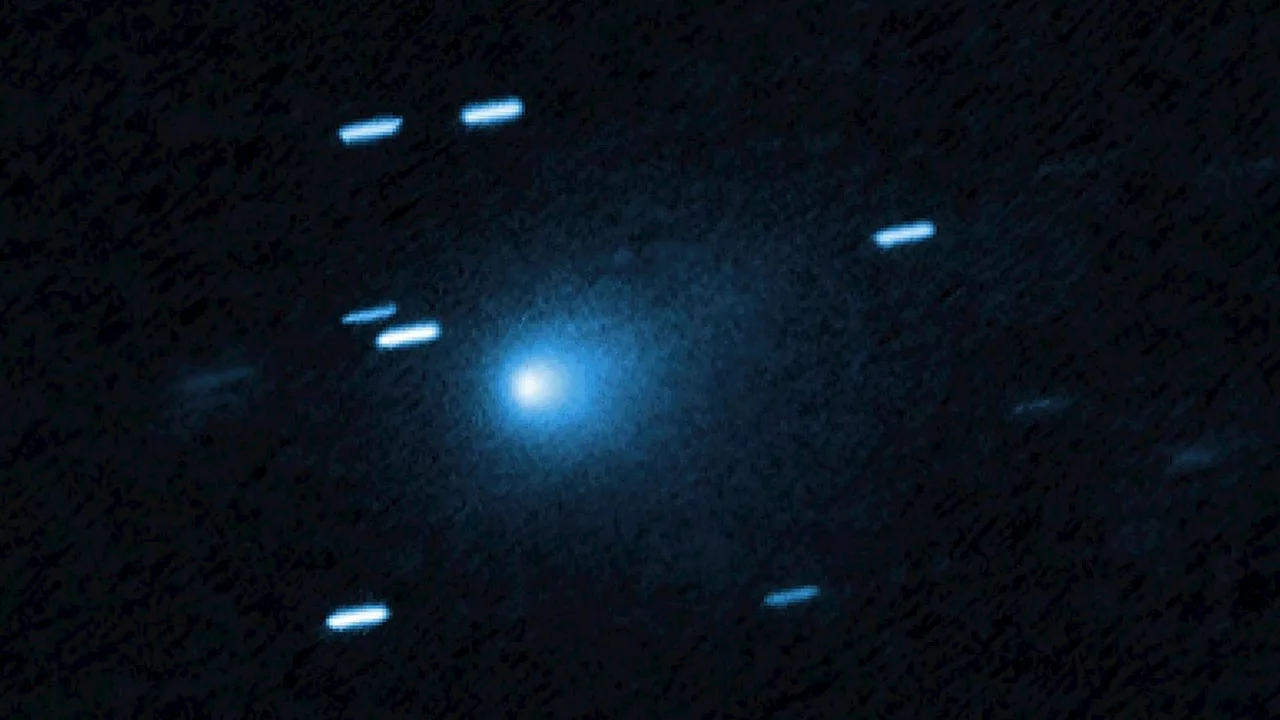
Scientists are investigating the interstellar object 3I/ATLAS, which has exhibited unexpected behaviors following its closest approach to the sun. This peculiar object, which passed perihelion on October 29, 2023, came within 203 million kilometers of the sun. Observations indicate it experienced non-gravitational acceleration and has displayed a bluer hue, characteristics atypical for comets. Notably, 3I/ATLAS lacks a cometary tail, raising significant questions about its composition and origin.
According to Dr. Avi Loeb, a theoretical physicist at Harvard University, the absence of a tail is particularly surprising considering the object’s proximity to the sun. New images suggest a blob of light instead of the expected tail, prompting further investigation into its makeup. “It should just make us curious,” Dr. Loeb stated, highlighting the mysteries surrounding 3I/ATLAS.
The object’s trajectory has sparked speculation about its potential connection to the ‘Wow’ signal, a mysterious radio signal detected in 1977. Dr. Loeb noted that 3I/ATLAS originated from the same direction as this enigmatic signal, which has puzzled scientists for decades. “We don’t know what the source is, but they were within nine degrees of each other. And the question is, were they related?” he added.
Scientific Perspectives on 3I/ATLAS
While some researchers entertain the idea that 3I/ATLAS could be a technological object, others advocate for a more conservative approach. Dr. Ken Gayley, an astronomy professor at the University of Iowa, emphasized the importance of investigating these objects as natural phenomena first. “We would always start off with the assumption that these are natural objects,” he explained. “If there’s really very powerful evidence that they’re not, then we might be led toward another direction. But for now, there’s still plenty of evidence that these are potentially just completely natural objects.”
3I/ATLAS is set to be closest to Earth on December 19, 2023. As this date approaches, scientists are eager to gather more data that may provide insights into not only 3I/ATLAS itself but also the formation conditions of other star systems. “That’s six days before Christmas,” Dr. Loeb humorously remarked. “And my hope is that we will not receive an unwanted gift for Christmas, for the holidays.”
NASA has clarified the naming conventions for comets. They are typically named after their discoverers; in this case, 3I/ATLAS is named after the team behind the Asteroid Terrestrial-impact Last Alert System survey telescope located in Rio Hurtado, Chile. The “I” in its designation stands for “interstellar,” indicating that it originated outside our solar system. 3I/ATLAS is the third known interstellar object, following the discoveries of 1I/Oumuamua in 2017 and 2I/Borisov in 2019.
As scientists continue to monitor 3I/ATLAS, they hope to unravel the mysteries surrounding this interstellar anomaly and deepen our understanding of the cosmos.