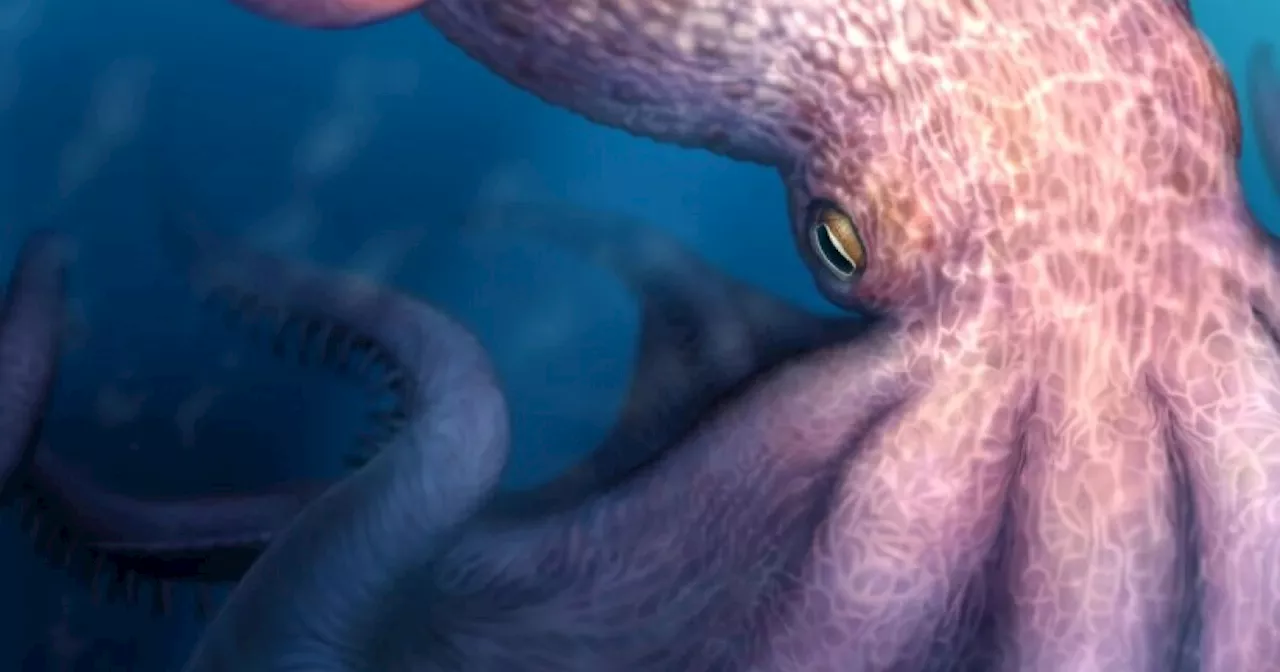
Fossil Discovery Reveals Colossal Octopus from 100 Million Years Ago
New research out of northern Japan has shattered previous assumptions about ancient marine life with the discovery of giant octopus fossils dating back 100 million years. Scientists found fossilized jaws so large they indicate creatures spanning up to 60 feet — longer than a California school bus — prowled ancient oceans alongside other apex predators.
The discovery, led by Ken Iba, a paleontologist at Hokkaido University, and colleague Günter Mutterlose from Ruhr University Bochum, uses cutting-edge digital scanning and AI technology to examine rock concretions that preserve rare soft-bodied fossils, such as those from octopuses, which typically leave little trace in the fossil record.
“Octopus fossils are extremely rare because they are almost entirely soft tissue,” said Iba. “Our digital fossil-mining technique enabled slicing the concretions and creating 3D reconstructions that revealed massive octopus jaws hidden inside.”
Jaws Reveal New Giant Cephalopod Predator
The fossilized jaws, robust enough to preserve over millions of years, resemble the beaks of modern octopuses but are significantly larger, suggesting these ancient creatures were formidable hunters. The lower jaw is described as shovel-like, adapted to cut through prey, which likely included shrimp, bivalves, lobsters, and shelled nautilus-like animals.
“These were active carnivores possibly hunting hard-shelled sea creatures and maybe even other predators,” Mutterlose explained. Both jaws display wear patterns, with the right side more eroded, indicating one-sided use and hinting at early advanced brain development.
Modern octopuses are known for intelligence and flexibility, and these fossils suggest some of those traits were already evolving during the late Cretaceous period. This research deepens our understanding of cephalopod evolution and late Cretaceous ecosystems, once teeming with large marine predators like the mosasaur.
Transforming Fossil Research with AI Technology
The team’s approach represents a breakthrough in paleontology. Instead of destructive excavation, the team digitally sliced through concretions—large rocks formed on the ancient seafloor—to non-invasively scan for hidden fossils using an AI-assisted model that constructed detailed 3D images from photos of thin rock layers.
“This approach allowed us to uncover remarkable evolutionary history locked inside these rocks without damaging them,” noted Mutterlose.
Impact on Understanding Ancient Oceans
This finding rewrites the known size and ecological roles of early octopuses and highlights a diverse, predator-rich ocean environment during the time, with multiple large carnivores competing for survival.
Understanding these giant octopuses sheds light on the complexity of marine ecosystems during the Cretaceous, underlining a dynamic and fierce underwater world far different from today’s oceans. It also pushes scientists to reconsider the evolutionary timeline of intelligence and specialization in cephalopods.
Continued research will focus on more specimens and refining AI techniques to unlock even more fossil secrets from rocks worldwide, promising new discoveries about ancient life beneath the waves.
“Just a few key fossil findings may shed very new light on the evolution of the biosphere,” said Mutterlose.
For California and the US, where octopus species are both biologically significant and culturally cherished, this groundbreaking discovery offers intriguing clues about the deep past and the roots of marine intelligence. Stay tuned as scientists dive deeper into these hidden ancient giants.