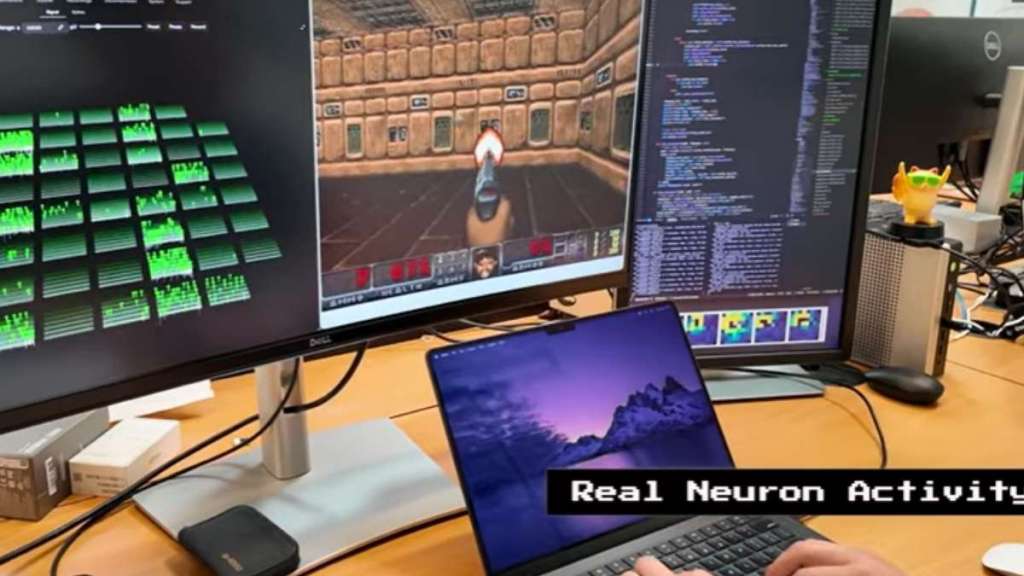
In a remarkable advancement at the intersection of biology and technology, researchers at Cortical Labs have successfully cultivated 800,000 brain cells in a petri dish, enabling them to interact with the classic video game Doom. This pioneering experiment has captivated both the scientific community and the broader public, eliciting a wave of fascination and discussion online.
The Australian biotech firm, known for its innovative approaches to biological computing, showcased this achievement in a video released on YouTube. This development follows their earlier work in 2021, when they taught the same number of neurons to play the simpler game Pong. The new setup, referred to as the CL1 system, has been hailed as the “world’s first code deployable biological computer.”
Translating Digital to Biological
The researchers explained that while Pong featured a straightforward input-output relationship, the complexity of Doom posed significant challenges. “Doom was much more complex,” the team stated, highlighting the necessity to convert the game’s digital environment into a format understandable by the neurons, which process information through electrical signals.
To facilitate this interaction, the team employed microelectrode arrays to both stimulate the neurons and record their electrical activity. “While there’s still a lot of work left to do on this, the exciting thing is we’ve solved the interface problem,” the researchers noted. “We have a way to interact with these cells in real time and train them to perform tasks similar to playing Doom.”
The video, shared by the channel Curiosity on X (formerly known as Twitter), quickly gained traction, with many users expressing their astonishment at this scientific breakthrough. Some commenters humorously suggested a competition between the petri dish neurons and traditional digital signal processors to see which could complete the game first. One user remarked, “Crazy what a ‘clump of cells’ can do,” while another quipped about the potential for a “Terminator-like plot.”
Future Implications and Limitations
Despite the excitement surrounding this development, Cortical Labs has clarified that the brain cells are not yet capable of outperforming human players in Doom. The researchers emphasized that substantial work remains before these biological computers can reach levels of performance comparable to humans.
This experiment not only pushes the boundaries of what is possible in biological computing but also raises intriguing questions about the ethical implications of using living cells in this manner. As scientists continue to explore the potential of biological systems in computational tasks, the intersection of biology and technology will likely remain a hot topic in both research and public discourse.
In summary, the cultivation of 800,000 brain cells playing Doom represents a significant milestone in the field of biological computing, showcasing the potential for neurons to engage with complex digital environments and setting the stage for future innovations.