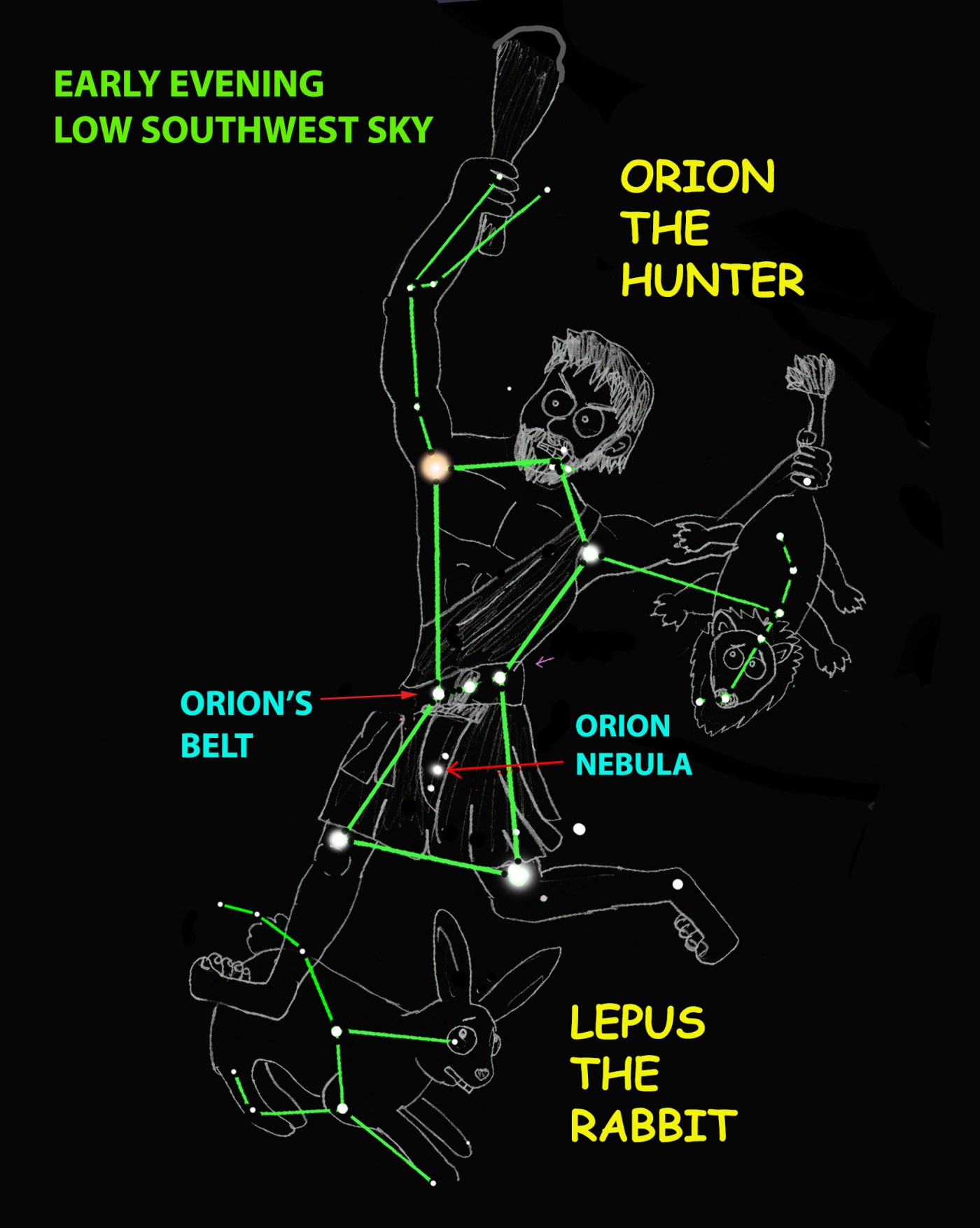
In the vast expanse of the winter sky, the constellation Lepus, or the Rabbit, offers a whimsical counterpart to the more prominent figures of the celestial map. While stargazers often focus on well-known patterns like Orion and Gemini, Lepus presents an intriguing story that connects mythology and astronomy.
During the winter months, dedicated stargazers in locations such as Pottsville have been treated to a stunning array of constellations. The grouping known as the winter hexagon includes bright formations like Taurus the Bull and the Canis Major and Canis Minor dogs. Orion, recognizable by his belt of three bright stars, dominates this celestial theater, with Lepus positioned just beneath his feet.
Lepus has a reputation for being less visible than its neighboring constellations. Its faint stars create a pattern that can be challenging to identify as a rabbit, especially for those viewing from urban areas. To truly appreciate Lepus, one would need to venture into darker, rural skies where the stars shine more brightly.
The tale of Lepus is steeped in ancient mythology. In Greek lore, Lepus serves as a comedic antagonist to the mighty hunter Orion. Just as Bugs Bunny playfully outsmarts Elmer Fudd, Lepus is depicted as a clever rabbit that continuously eludes Orion’s attempts to catch him. This amusing dynamic adds a layer of personality to the constellation, highlighting the interplay between hunter and hunted.
According to myth, Orion was a formidable hunter who could track down any beast. Yet, he found himself frustrated by Lepus, who not only pilfered his garden but also harassed him during hunts. Just as Orion prepared to strike, Lepus would leap onto his head or disrupt his concentration, making him a source of comic relief in the hunter’s otherwise serious pursuits.
The story takes a darker turn when the king of the gods, Zeus, intervenes. Zeus learned of Orion’s budding romance with his daughter, the moon goddess Artemis. Concerned for her well-being, Zeus sent a giant scorpion to confront Orion while he slept. In a fierce battle, the scorpion fatally wounded the hunter. Heartbroken, Artemis transformed Orion’s body into a constellation, allowing her to see him every night as she guided the moon across the sky.
In this celestial narrative, Lepus was not forgotten. The rabbit joined Orion and his hunting dogs in the night sky, symbolizing the eternal chase and the interplay of life and death. This mythological backdrop provides a rich context for stargazers who look up at the winter sky.
As winter progresses, those interested in astronomy can take the opportunity to explore Lepus and the surrounding constellations. While it may be a challenge to spot the Rabbit among the more dominant figures, the story behind it enriches the experience of stargazing.
For more insights into the night sky, amateur astronomer and retired broadcast meteorologist Mike Lynch invites readers to appreciate the humor and history behind these celestial patterns. Interested individuals can reach out to Lynch at [email protected] for further discussions on the wonders of astronomy.
In the end, Lepus serves as a reminder of the playful side of the cosmos, where even the smallest figures hold significant stories in the tapestry of the night sky.