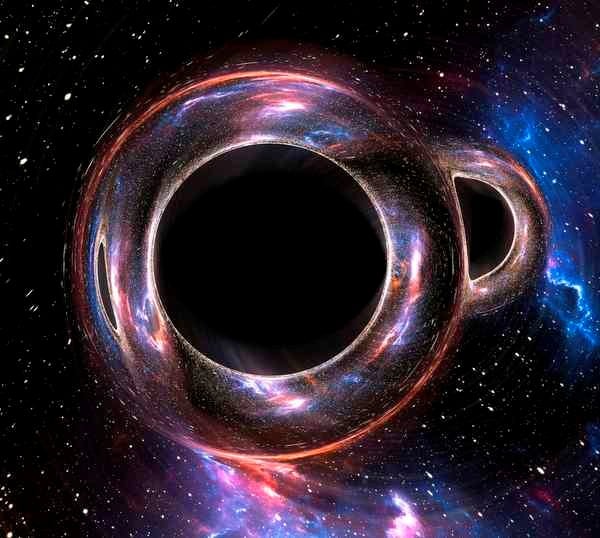
On January 14, 2025, scientists detected a remarkable gravitational wave signal, designated GW250114, marking a significant milestone in astrophysics. This signal, captured by the twin Laser Interferometer Gravitational Wave Observatories (LIGO) in the United States, originated from the collision of two black holes deep in space. The clarity of this detection has provided unprecedented opportunities to explore the fundamental principles of our universe, particularly Albert Einstein’s theory of general relativity.
The enhanced quality of the gravitational wave signal has allowed researchers to conduct more refined tests of how gravity operates. When two black holes merge, the resulting black hole emits gravitational waves that resonate like a struck bell. This phenomenon produces specific frequencies that diminish over time. Each frequency, or “tone,” is defined by two key characteristics: its oscillation rate and the rate at which it fades.
Measuring a single tone can yield insights into the mass and spin of the newly formed black hole. However, obtaining multiple tones from the same event provides independent measurements of the black hole’s properties. For GW250114, the research team successfully measured two distinct tones and constrained a third, all of which align perfectly with Einstein’s predictions about gravitational waves. This success reinforces the validity of general relativity once again.
Implications for Future Research
Despite the confirmation of Einstein’s theory through this latest discovery, physicists such as Keefe Mitman remain cautious. They acknowledge that general relativity does not fully account for phenomena such as dark matter and dark energy, nor does it integrate seamlessly with quantum mechanics. The mathematical framework of general relativity encounters significant challenges when attempting to explain gravity at quantum scales.
The findings from GW250114 stand as both a validation and a beacon of hope for physicists. While general relativity remains unchallenged, the increasing sensitivity of gravitational wave detectors is steering researchers closer to uncovering the limitations of the theory. As they continue to explore these boundaries, the potential exists for groundbreaking revelations about the fundamental workings of the universe.
As science progresses, each new gravitational wave detection not only deepens our understanding of the cosmos but also pushes the boundaries of what we know about the laws governing it. The journey to unravel the mysteries of dark matter, dark energy, and the quantum nature of gravity continues, guided by the insights provided through signals like GW250114.