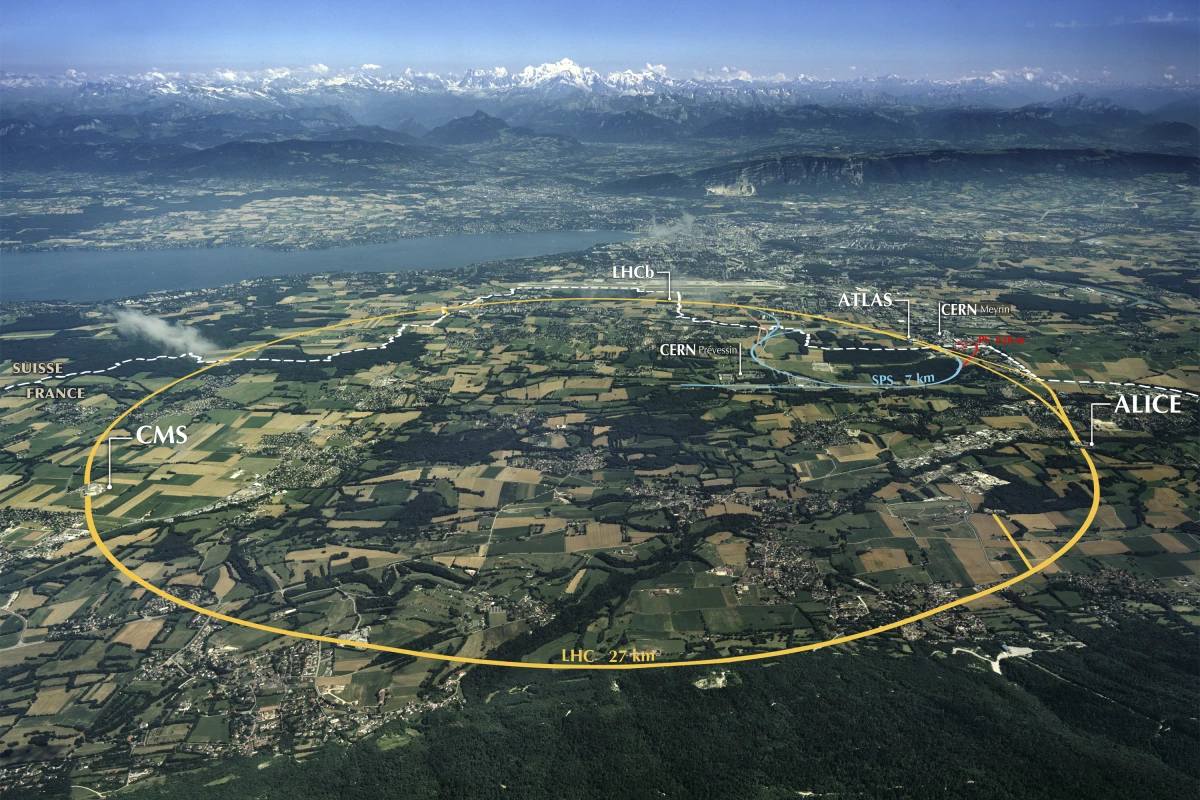
The Large Hadron Collider (LHC) at CERN is now contributing to local energy solutions by transforming waste heat into sustainable warmth for homes in the surrounding area. Located near the town of Ferney-Voltaire, the LHC has implemented a new system to capture excess heat generated during its operations, benefiting several thousand residential and commercial properties.
With a remarkable circumference of 26.7 kilometers (or 16.6 miles), the LHC stands as the largest particle accelerator globally. It operates by accelerating subatomic particles to near-light speeds, resulting in significant energy consumption, estimated between 600 and 750 GWh each year. Until recently, the excess heat produced during these experiments was released into the atmosphere via evaporation cooling towers.
In a shift towards sustainability, CERN has partnered with local authorities to redirect this waste heat into a district heating system. This initiative is part of the Large Hadron Collider beauty (LHCb) experiment, which aims to enhance the environmental impact of the facility. The system was inaugurated in December 2023 and is now fully operational.
According to CERN’s energy coordinator, Nicolas Bellegarde, the new set-up involves the installation of two 5-MW heat exchangers at the Point 8 installation of the accelerator ring. “Typically, hot water would pass through a cooling tower, releasing heat into the atmosphere so that the cooled water could be reinjected into the equipment,” Bellegarde explained. “In the new configuration, hot water initially passes through these heat exchangers, transferring thermal energy to the new heating network in Ferney-Voltaire.”
This innovative approach not only minimizes waste but also supports the local community by providing a reliable energy source for heating. The system serves the Zone d’Aménagement Concerté Ferney-Genève Innovation development area, marking a significant step in CERN’s commitment to sustainability and community engagement.
As the LHC continues to push the boundaries of particle physics, its new role in local energy provision showcases how cutting-edge science can intersect with practical, everyday applications. This development illustrates a growing trend in which large scientific facilities are finding ways to contribute positively to their local environments.