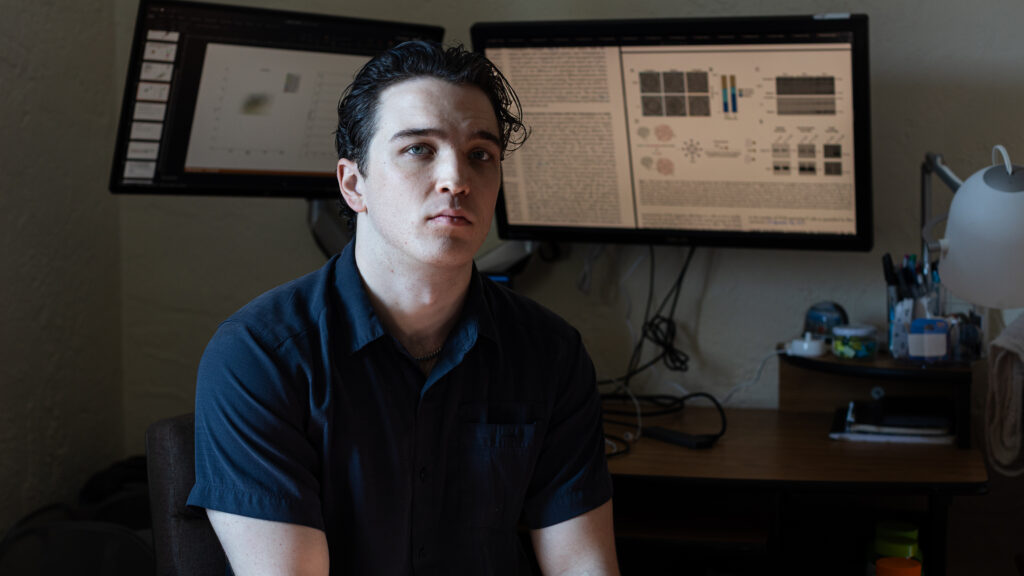
First-year biomedical Ph.D. students across the United States are facing significant hurdles as funding for labs becomes increasingly precarious. The National Institutes of Health (NIH) has cut back on the number of projects it supports, contributing to a highly competitive atmosphere for aspiring scientists. Many students, including Alex Sathler, who recently received a prestigious National Science Foundation fellowship worth $37,000 annually for three years, are struggling to find suitable lab placements for their research.
Sathler, who is enrolled in a collaborative program between the University of California, Berkeley, and UC San Francisco, experienced firsthand the tightening of funding opportunities when he was turned away by two laboratories. Both lab heads expressed their inability to take on more students due to budget limitations. “The real sense that I get is that there aren’t enough labs with funding to give everyone their best fit,” Sathler noted, reflecting a broader sentiment shared by many in his cohort.
The situation is not unique to Sathler. Numerous first-year biomedical graduate students report similar challenges in securing lab positions. According to Chevelle Newsome, president of the Council of Graduate Schools, the funding squeeze is a widespread issue affecting students nationwide. “The strain that you’re hearing is real. It’s not an isolated case. It’s actually across the board,” Newsome stated.
As NIH funding has declined, competition for positions in well-funded labs has intensified. Some students find themselves working on projects that do not align with their interests, while others are left waiting for lab placements, unsure of their futures in academic research.
Institutional Responses to Funding Cuts
In response to these challenges, some Ph.D. programs have proactively reduced their incoming class sizes. Last year, a number of institutions cut enrollment by a third or more, anticipating significant funding cuts from the previous administration. Yet, recent data indicates that overall biomedical graduate enrollment saw a slight increase last fall, suggesting a complex landscape for prospective students.
Life science Ph.D. students typically engage in lab rotations during their first year, allowing them to explore various research environments before committing to a specific group. However, this year, many students have encountered roadblocks. Hannah Barsouk, a biochemistry student at Stanford University, reported that six to ten labs she contacted indicated uncertainty about their ability to accept new students. This uncertainty creates a “cloud of general anxiety” for first-year students, as they navigate the competitive atmosphere of lab placements.
Some institutions have adapted their admission processes in light of funding uncertainties. For example, Georgia Tech and Emory University shifted to a direct-admission model for their joint bioengineering program, requiring applicants to secure a lab before being offered admission. While this approach is more common in Europe, it places significant pressure on students to rely on conversations with lab members rather than firsthand experience to find suitable research opportunities.
Long-Term Implications for Future Scientists
The funding landscape is not just affecting immediate placements; it raises concerns about the long-term viability of scientific careers for many students. In some cases, faculty members have withdrawn initial commitments due to financial constraints. One biology student, who wished to remain anonymous, shared her experience of being assured a position in a lab only to find that the professor later implied her acceptance depended on securing additional funding through a fellowship.
Sathler’s experience echoes this sentiment. Despite his NSF fellowship, he has faced challenges, as some labs have indicated that the funding does not fully cover the salary requirements. This trend has been noted in seminar courses designed to attract first-year students to faculty labs, where participation has declined due to funding insecurities.
While there is hope that funding conditions could improve, the current climate has left many students uncertain about their futures. Some students, like the anonymous biology Ph.D. candidate, have even sought admission to other graduate programs, feeling their current path may not lead to their desired outcomes. “I still very much want to be a professor, and I just don’t know if that’s ever going to be possible because of the way NIH and the NSF are being dismantled,” she expressed.
As the academic landscape evolves in response to funding challenges, students are left grappling with their ambitions and the realities of a competitive research environment. The outcome of ongoing budget discussions may provide some relief, but until then, aspiring scientists remain in a precarious position, navigating their paths in an increasingly uncertain world of academic research.