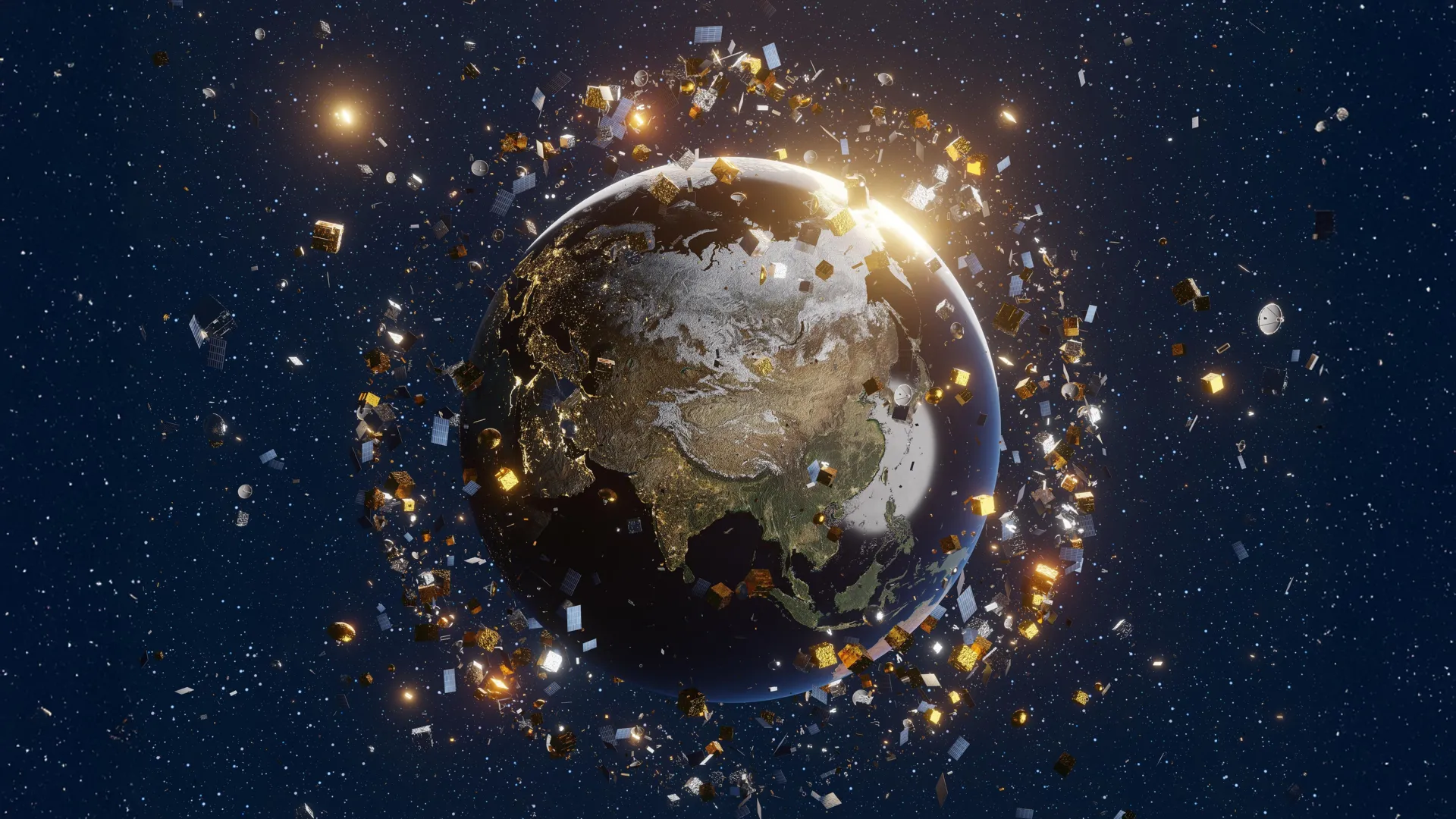
Low-Earth orbit (LEO) is on the brink of a catastrophic disaster, with new calculations indicating that a complete loss of control over satellite navigation could lead to significant collisions in as little as 2.8 days. This alarming conclusion comes from a study led by Sarah Thiele, a researcher at Princeton University and former PhD student at the University of British Columbia, which highlights the increasing fragility of our satellite networks.
As LEO becomes increasingly crowded, satellites are frequently maneuvering to avoid collisions. With an average of one “close approach,” defined as two satellites coming within less than 1 km of each other, occurring approximately every 22 seconds, the risk of accidents is escalating. Within the Starlink network alone, these close encounters happen roughly every 11 minutes. To mitigate the threat of collisions, each Starlink satellite performs an average of 41 course corrections annually.
Understanding the Risks of Solar Storms
While constant maneuvering might suggest a functioning system, engineers recognize that failures often arise from rare, unpredictable events. The study emphasizes that solar storms pose a significant threat to satellite operations. These storms can disrupt satellites in two primary ways: by heating the atmosphere and interfering with navigation and communication systems.
When a solar storm impacts Earth, it causes the upper atmosphere to expand, increasing drag on satellites. This added resistance forces satellites to expend more fuel to maintain their orbits and complicates precise positioning. For instance, during the Gannon Storm in May 2024, over half of all satellites in LEO had to adjust their trajectories due to increased atmospheric drag.
The second, more severe effect of solar storms can lead to complete failure of satellite navigation and communication systems. If satellites lose this control, they become unable to respond to potential collisions, creating a dangerous environment in which accidents can escalate rapidly.
Measuring the Imminent Threat
The research introduces a new metric called the Collision Realization and Significant Harm (CRASH) Clock to assess the speed of potential disasters in LEO. By June 2025, researchers determined that a loss of command over satellite avoidance maneuvers could result in a catastrophic collision in just 2.8 days. In contrast, similar conditions in 2018, before the rise of mega constellations, would have allowed for approximately 121 days before such a collision occurred.
The risk becomes even more pronounced over shorter periods. A mere 24-hour loss of control could lead to a 30% chance of a significant collision, potentially triggering a chain reaction known as Kessler syndrome. This phenomenon involves the accumulation of debris from collisions, making it increasingly difficult to launch new spacecraft without risking destruction.
One of the most concerning aspects of solar storms is their unpredictable nature. Warnings often come only a day or two in advance, leaving satellite operators with limited options to protect vulnerable systems. The rapidly changing atmospheric conditions created by solar storms necessitate constant monitoring and real-time control. If control is lost, the study suggests that operators have only a few days to restore it before the entire system collapses.
The Gannon Storm, while the strongest in decades, was not the most powerful on record. The Carrington Event of 1859 holds that distinction. Should a storm of similar intensity occur today, it could disrupt satellite operations far longer than three days, leading to severe damage to global satellite infrastructure.
As technology continues to advance, the risks associated with satellite mega constellations must be carefully considered. While these networks offer significant advantages, the potential consequences of losing access to space for generations due to a singular solar storm cannot be overstated. This research underscores the critical need for informed decision-making regarding our reliance on an increasingly interconnected sky.