The Chandra X-ray Observatory has significantly enhanced its catalog of cosmic observations, now totaling over 1.3 million individual X-ray detections. This update, released on January 25, 2026, includes data from the Chandra Source Catalog (CSC), which compiles X-ray data collected up to the end of 2020.
Insights from the Chandra Source Catalog
The latest version of the CSC, referred to as CSC 2.1, encompasses more than 400,000 unique sources, both compact and extended. This extensive catalog offers a treasure trove of information, including exact positions of X-ray sources and detailed data on the energies detected. This richness allows scientists to integrate Chandra’s X-ray data with observations from various other telescopes, such as NASA’s James Webb and Hubble Space Telescopes.
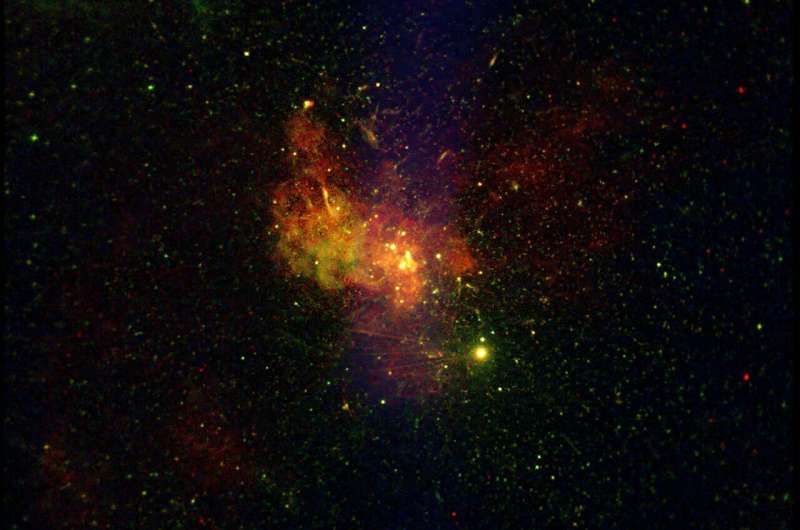
A vivid illustration of the catalog’s depth is displayed in a new image of the Galactic Center, which surrounds the supermassive black hole known as Sagittarius A*. In this region, which spans only about 60 light-years, Chandra has identified over 3,300 distinct X-ray sources. The image itself is a composite of 86 observations, summing up to over three million seconds of observation time.
Innovative Representations of Data
The Chandra team has also released a sonification—a conversion of astronomical data into sound—demonstrating the extensive range of observations collected over 22 years, from its launch in 1999 through 2021. The sonification provides an auditory representation of the X-ray sources, indicating how many times each source has been detected over time with different notes.
The visual format of this representation features a map of the sky where the core of the Milky Way is at the center, and the Galactic plane runs horizontally. Each detection is marked by a circle, the size of which reflects the frequency of detections in that spot. A year counter at the top of the frame indicates the timeline of the data, transitioning to “… and beyond” to signify that Chandra remains fully operational and continues to gather observations.
As a testament to the ongoing success of the Chandra mission, these updates not only bolster scientific research but also enhance the collaborative efforts of astronomers worldwide. The most recent version of the Chandra Source Catalog is available for public access at the Chandra X-ray Center’s website: [Chandra Source Catalog](https://cxc.cfa.harvard.edu/csc/).
With its unmatched catalog, the Chandra X-ray Observatory solidifies its position as a leader in the field of X-ray astronomy, providing invaluable resources for furthering our understanding of the universe.