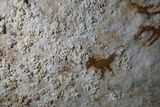
Recent research has confirmed that the oldest known rock art, a human hand stencil, is over 67,000 years old. Discovered in a cave on Sulawesi, Indonesia, this artwork provides significant insights into early human migrations, possibly connecting to the ancestors of Aboriginal Australians. The findings, published in the journal Nature, indicate that this stencil predates other known rock art in the region by approximately 16,600 years.
The stencil, located in the Liang Metanduno cave, presents a faint outline that resembles a claw-like human hand. According to study author Maxime Aubert from the Griffith Centre for Social and Cultural Research in Australia, this discovery highlights Sulawesi’s importance as a site of early artistic expression, with roots tracing back at least 67,800 years.
Significance of Sulawesi in Human History
Sulawesi has long been recognized as a crucial location in the narrative of human history. It has preserved some of the most ancient cave art, including depictions of both human and animal figures. This latest research builds upon previous studies that revealed possible hunting scenes, further emphasizing the island’s role as a hub for artistic innovation and cultural development.
The archipelago may have facilitated early human movements, acting as a stepping stone for Homo sapiens migrating from Asia to Sahul, the ancient landmass that linked Australia, New Guinea, and Tasmania. The study authors suggest that the artists behind the rock art were likely connected to the ancestors of the First Australians.
In a concerted effort to uncover more about the art and migrations of early humans, the research team examined various ancient rock art pieces across Sulawesi and nearby islands. Among these were several stencils of human hands, including the oldest discovered in the Liang Metanduno cave, which had been modified to resemble a claw.
Utilizing advanced techniques such as uranium-series dating and mineral deposit analysis, the researchers determined that this distinctive stencil was created around 67,800 years ago. This finding supports the notion that the creators were part of a broader population that subsequently spread throughout the region, ultimately reaching Australia.
Insights into Migration Patterns
Previously published research has proposed two timelines for the arrival of Homo sapiens in Sahul: the “long chronology” around 65,000 years ago and the “short chronology” around 50,000 years ago. Furthermore, it suggested that modern humans arrived on the paleocontinent via two distinct island-hopping routes. The northern route, traced through Sulawesi, and the southern route, passing through Timor, led to the respective New Guinean and Australian regions of Sahul.
The Liang Metanduno cave also contains younger paintings, indicating a significant period of occupation that may extend for over 35,000 years. According to study author Renaud Joannes-Boyau from the Geoarchaeology and Archaeometry Research Group at Southern Cross University, the dating of this ancient rock art provides the earliest direct evidence of modern humans along this northern migration corridor into Sahul.
Looking ahead, the research team aims to continue exploring sites along the northern migration route into Sahul. Aubert emphasized the archaeological significance of the numerous Indonesian islands situated between Sulawesi and New Guinea, suggesting they may hold further evidence of ancient human activity.
The findings from this study underscore the enduring legacy of Sulawesi as a vital location for understanding the artistic and migratory patterns of early human populations. As researchers delve deeper, they hope to shed more light on the connections between ancient cultures and the broader narrative of human history.