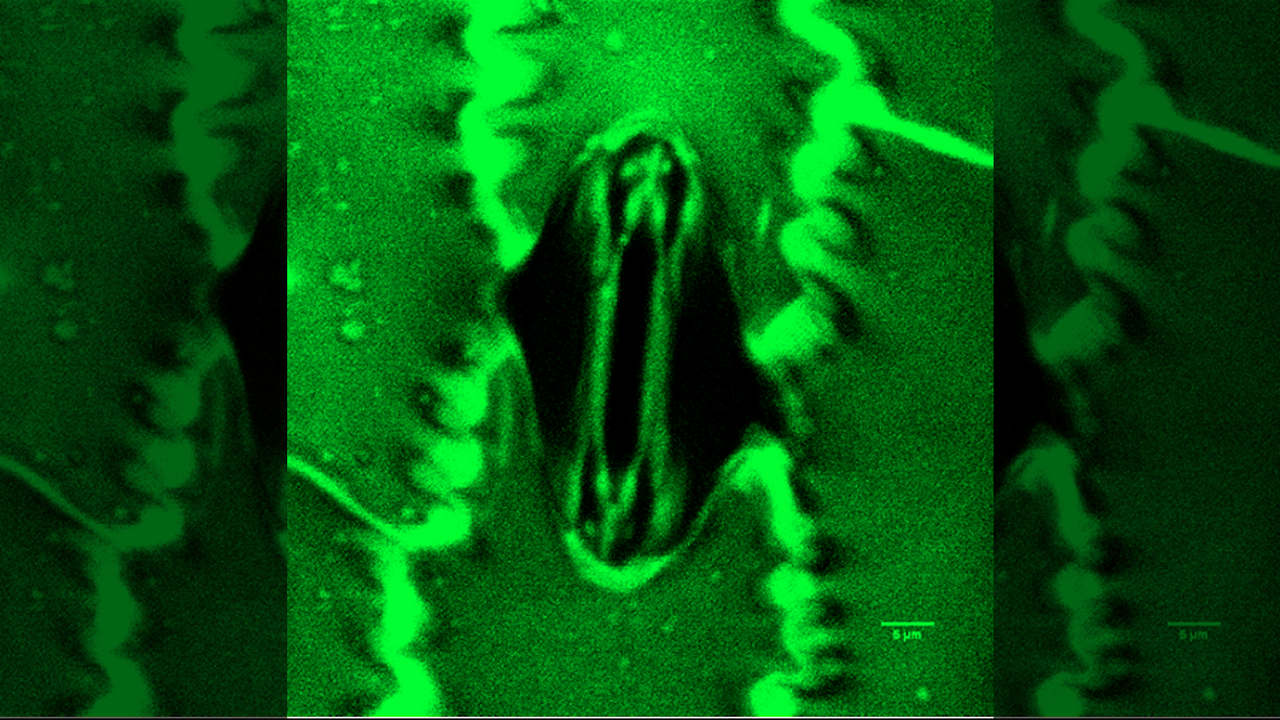
Researchers have unveiled a groundbreaking tool, the Stomata In-Sight, which enables scientists to observe how plants breathe in real time. This innovative technology could play a crucial role in identifying genetic traits that enhance crop resilience to the impacts of climate change. The tool’s development was detailed in a study published on November 17, 2025, in the journal Plant Physiology.
Plants rely on tiny pores known as stomata to regulate carbon dioxide intake and oxygen and water vapor release. These microscopic structures are vital for plant health and agricultural productivity. According to Andrew Leakey, a plant biologist at the University of Illinois Urbana-Champaign, understanding stomata better is essential for improving crop efficiency, particularly for varieties requiring less water.
The Stomata In-Sight tool incorporates a microscope, a gas exchange measurement system, and machine-learning image analysis to assess the activity of numerous stomata simultaneously. “It measures the collective activity of thousands upon thousands of stomata in terms of carbon dioxide and water fluxes,” Leakey explained. Researchers place small leaf samples in a climate-controlled chamber, which is roughly the size of a human palm, connected to a gas exchange system. Conditions within the chamber can be modified to observe stomatal responses to varying temperature and water availability.
Despite the advancements, the research team faced challenges in the tool’s development. Tiny vibrations from the gas-exchange system led to blurry images, resulting in a lengthy five-year process with multiple prototypes before achieving a functional design. The team has already utilized the tool to study the stomata of maize (Zea mays) and sorghum (Sorghum bicolor), discovering genes that influence stomatal density. By engineering sorghum with more widely spaced stomata, they aim to enhance water efficiency in these crops.
While the University of Illinois has patented the technology, it is not yet commercially available. Leakey expresses optimism that companies may show interest in producing the instrument for broader research applications.
Not everyone in the scientific community is convinced of the tool’s transformative potential. Alistair Hetherington, an emeritus professor of botany at the University of Bristol, raised concerns about the necessity of this new approach. He noted that conventional microscopy and gas exchange techniques have been effective for decades. “Researchers are likely to stick to tried and tested existing techniques that deliver,” Hetherington stated.
Despite differing opinions, Leakey is focused on refining the tool to enhance its practicality. Currently, observing stomata “breathing” is a labor-intensive process requiring scientists to measure multiple stomata manually. As it takes time for stomata to respond to environmental changes, researchers often need to wait several minutes before capturing new images. Leakey envisions the potential use of robotics and artificial intelligence to streamline this process, making it more efficient.
The excitement surrounding the Stomata In-Sight tool reflects a broader interest within the scientific community in accelerating biological research through innovative technologies. As challenges related to climate change intensify, tools that enhance our understanding of plant responses to environmental factors will be increasingly vital for developing sustainable agricultural practices.