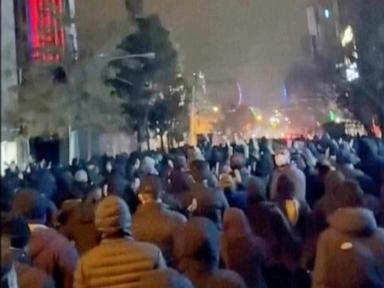
Nationwide protests challenging Iran’s theocracy have resulted in at least 116 deaths over the past two weeks, according to reports from activist groups. Demonstrators have taken to the streets in cities including the capital, Tehran, and the second-largest city, Mashhad, as they voice their discontent against the government. The unrest has intensified since the protests began on December 28, 2023, triggered by the collapse of the Iranian rial, which is currently trading at over 1.4 million IRR to 1 USD.
The situation has become increasingly dire as the Iranian government has implemented an internet blackout and cut off telephone lines, complicating efforts to gather information from within the country. The U.S.-based Human Rights Activists News Agency reported that approximately 2,600 individuals have been detained amid the protests. Activists and observers fear that the information blackout could embolden hard-liners within Iran’s security forces to carry out a more violent crackdown on demonstrators.
In a show of support for the protesters, U.S. President Donald Trump stated on social media that “Iran is looking at FREEDOM, perhaps like never before. The USA stands ready to help!!!” Reports indicate that Trump has been presented with military options regarding a potential strike on Iran, though he has not yet made a final decision. The U.S. State Department cautioned Iranian officials not to underestimate Trump’s resolve.
Escalating Tensions and Government Responses
Video footage reportedly sent from Iran has depicted crowds gathering in neighborhoods such as Punak in northern Tehran, with protesters waving lit mobile phones amid a backdrop of fireworks and metal clanging. Other clips from Mashhad showed confrontations between protesters and security forces, with debris blocking streets. The significance of protests in Mashhad is particularly notable due to its status as the site of the Imam Reza shrine, the holiest site in Shiite Islam.
In a stark warning, Iranian Attorney General Mohammad Movahedi Azad declared that participants in the protests would be considered “enemies of God,” a charge that carries the death penalty. The Iranian government has signaled a forthcoming crackdown despite international warnings, escalating its rhetoric against demonstrators.
State-affiliated media have attempted to portray a sense of calm in various areas, showcasing correspondents in cities like Qom and Qazvin but notably omitting Tehran and Mashhad. This effort appears designed to counter the narratives of unrest coming from protest hotspots.
Historical Context and Calls for Action
The roots of the current unrest trace back to widespread dissatisfaction with the Iranian government, exacerbated by economic challenges stemming from international sanctions related to its nuclear program. The protests have evolved from initial economic grievances into broader demands for a challenge to the theocratic regime itself.
Exiled Crown Prince Reza Pahlavi, a prominent figure in the Iranian diaspora, has called for continued demonstrations and urged protesters to carry the old lion-and-sun flag, a symbol associated with the pre-1979 monarchy. His calls have evoked mixed reactions, as some demonstrators express nostalgia for the era before the Islamic Revolution, while others question whether their support aligns with Pahlavi himself or a desire for a different political future.
As the situation develops, the world watches closely, with many fearing that the Iranian government’s response could lead to further violence. The ongoing protests represent a pivotal moment in Iran’s history, as citizens continue to push against the prevailing political order in the face of significant risk.