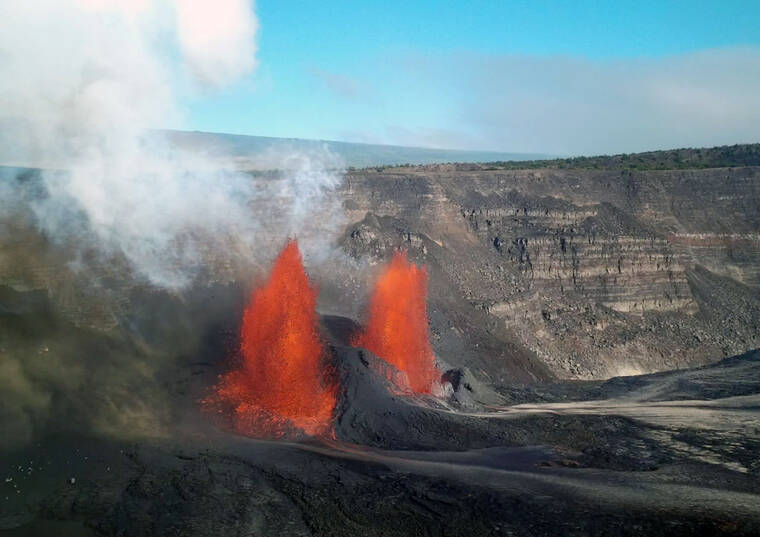
UPDATE: Kilauea volcano in Hawaii is erupting spectacularly with new lava fountains reaching heights of 1,574 feet (480 meters). The latest episode, which began on December 23, 2024, showcases the volcano’s ongoing activity as it celebrates the New Year with thrilling lava displays.
Over the past year, Kilauea has produced a staggering total of 200 million cubic meters (300 million cubic yards) of lava, significantly surpassing average annual outputs from previous eruptions. This explosive activity is not only mesmerizing tourists but also reshaping the landscape of Hawaii Volcanoes National Park.
The latest lava fountaining episode, dubbed Episode 39, erupted for 6 hours from both the north and south vents, reaching impressive heights of approximately 1,400 feet (425 meters). This marks a continuation of Kilauea’s dynamic volcanic behavior, which includes a series of fountains peaking higher than ever before.
The United States Geological Survey (USGS) has confirmed that Kilauea’s current Volcano Alert Level is set at WATCH, suggesting heightened vigilance as the volcano could erupt again soon. The USGS projects another fountaining episode could occur between January 8 and 14, as the summit continues to reinflate.
“The episodic nature of the fountaining events allows us to forecast their onsets, but we remain vigilant for potential changes,” stated Ingrid Johanson, a research geophysicist with the USGS Hawaiian Volcano Observatory.
Throughout 2025, Kilauea has set numerous records for both fountain heights and lava volume. Notably, Episode 3, which took place from December 26, 2024, to January 3, 2025, holds the record for the most lava erupted during a single episode at 13 million cubic meters (17 million cubic yards). Meanwhile, Episode 38, which erupted on December 6, 2025, followed closely behind with an impressive 12.1 million cubic meters (15.8 million cubic yards) in just 12 hours.
The dramatic rise in lava levels has elevated the crater floor by an average of 225 feet (69 meters), while the vent bases have risen nearly 450 feet (137 meters). This elevation change has led to more tephra—tiny lava particles—being blown over the caldera rim, impacting areas further from the eruption site.
As Kilauea continues to dazzle with its fiery displays, safety remains a priority. Officials urge the public to observe from safe distances, especially as the eruption patterns can change rapidly. The USGS has reported no unusual activity along Kilauea’s East Rift Zone or Southwest Rift Zone, while Mauna Loa remains non-eruptive with a Volcano Alert Level of NORMAL.
For those eager to witness the spectacle, Kilauea promises to be a captivating destination in 2025. Stay tuned for further updates as scientists monitor the volcano closely. Visit the USGS Hawaiian Volcano Observatory for ongoing reports, photos, and safety information.
This is an exciting time for both locals and visitors to experience the raw power of nature. Share this urgent update and keep an eye on Kilauea—its next performance might be just around the corner!