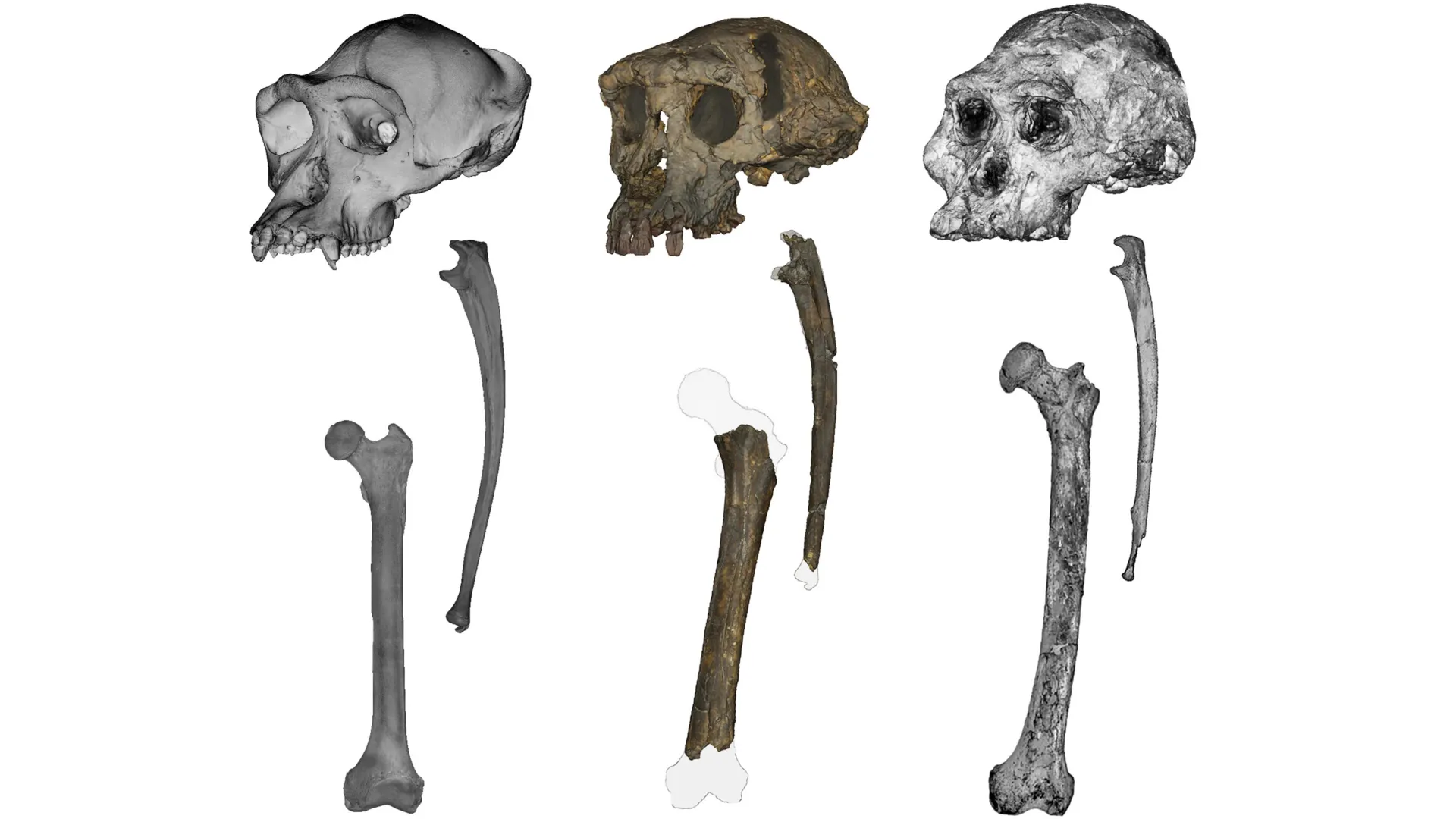
UPDATE: Groundbreaking research just released confirms that the ancient fossil, Sahelanthropus tchadensis, could walk on two legs, potentially redefining our understanding of human origins. This remarkable finding, published today, January 3, 2026, by scientists from New York University and collaborating institutions, reveals strong anatomical evidence that this seven-million-year-old species was indeed bipedal.
The implications of this discovery are enormous. If Sahelanthropus is confirmed as a human ancestor capable of upright walking, it would position bipedalism at the very foundation of the human family tree. For decades, scientists debated the locomotion of this fossil, but new research finally provides clarity.
Utilizing advanced 3D imaging techniques, researchers identified a crucial skeletal feature—the femoral tubercle—unique to bipedal human ancestors. This small yet significant structure serves as the attachment point for the iliofemoral ligament, the strongest ligament in the human body, essential for standing and walking upright. Alongside this, additional anatomical traits further support the idea that Sahelanthropus moved confidently on two legs.
Scott Williams, lead author and associate professor at New York University, stated, “
Sahelanthropus tchadensis was essentially a bipedal ape that possessed a chimpanzee-sized brain and likely spent a significant portion of its time in trees, foraging and seeking safety.
Despite its superficial appearance, Sahelanthropus was adapted to using bipedal posture and movement on the ground.”
This pivotal study draws on a collaborative effort from scientists at the University of Washington, Chaffey College, and the University of Chicago. The research not only highlights the fossil’s unique features but also confirms its significance in the evolutionary timeline.
The Djurab Desert in Chad is where this fossil was first discovered by paleontologists from the University of Poitiers in the early 2000s. Historically, research focused on the skull, which limited insights into locomotion. However, recent examinations of additional bones, particularly the femur and ulnae, have reignited debates on whether Sahelanthropus qualifies as a hominin.
The comprehensive analysis utilized two approaches: comparing bone traits with those from both modern and extinct species and applying 3D geometric morphometrics to analyze detailed bone shapes. Notably, the study compared Sahelanthropus with Australopithecus, another early human ancestor, further illuminating the evolutionary journey toward bipedalism.
Researchers identified three key features that indicate upright walking: femoral antetorsion, the gluteal complex, and the ratio of limb proportions. While Sahelanthropus had shorter legs than modern humans, its limb proportions resemble those of early hominins, suggesting a significant evolutionary step toward bipedalism.
Williams concluded, “
Our analysis of these fossils offers direct evidence that Sahelanthropus tchadensis could walk on two legs, demonstrating that bipedalism evolved early in our lineage and from an ancestor that looked most similar to today’s chimpanzees and bonobos.
”
This study, funded by the National Science Foundation, is set to challenge long-held beliefs about human evolution and the timeline of our ancestors. Researchers and enthusiasts alike are eager to see how this finding will reshape our understanding of where we come from.
Stay tuned for further developments as the scientific community continues to explore the implications of this extraordinary discovery. Sharing this news could spark crucial discussions about human evolution and our place in the natural world!