China has officially placed its first supercritical carbon dioxide (CO2) power generator, known as Chaotan One, into commercial operation at a steel plant located in Guizhou Province. This system is designed to recover industrial waste heat and convert it into electricity, representing what many are calling a technological breakthrough. Each generator unit is rated at approximately 15 MW, with configurations totaling around 30 MW.
The claimed efficiency improvements of this system are significant, with reports suggesting enhancements of between 20% and over 30% in heat-to-power conversion compared to traditional steam-based waste heat recovery systems. While these figures are impressive, the historical context raises questions about the long-term viability of such advancements. China’s track record in deploying first-of-a-kind systems often leads to a mixed bag of outcomes, with the potential for both innovation and failure.
Despite the ambitious claims, skepticism is warranted. China has a history of developing technologies that initially appear promising but may not endure in practical applications. The nation’s approach to technology development often involves a philosophy likened to “crossing the river by feeling for stones,” allowing it to learn from both successes and failures. This iterative process does not always guarantee that new technologies will become economically viable or widely replicable.
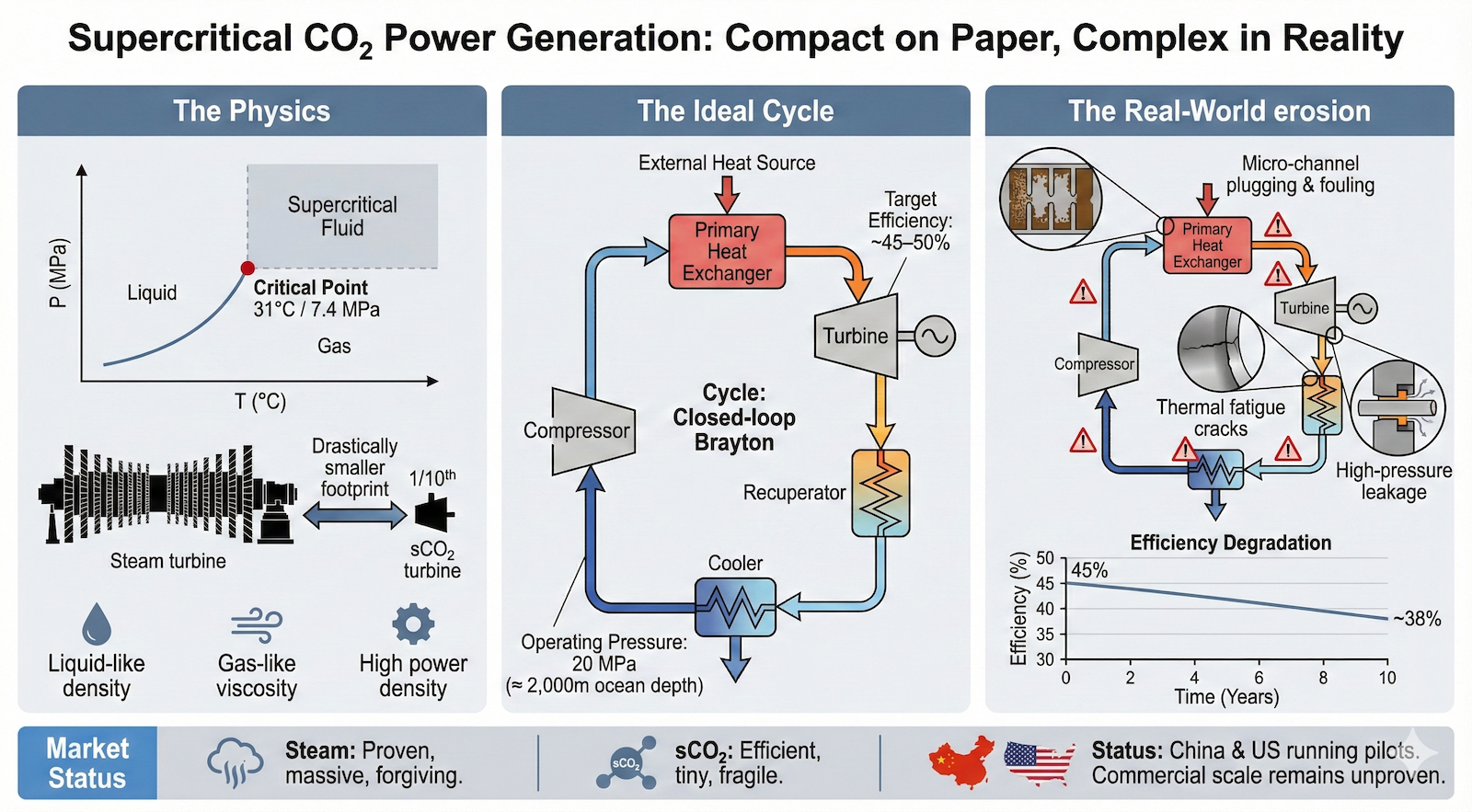
One critical aspect of the supercritical CO2 system is its operational efficiency. The technology utilizes carbon dioxide, which enters a supercritical state under high pressure and temperature. At around 31° Celsius (approximately 88° Fahrenheit) and pressures around 200 atmospheres, CO2 exhibits properties that make it highly efficient for power generation. However, the same characteristics that enhance its performance can also lead to vulnerabilities in real-world conditions.
In contrast to China’s deployment, the United States has approached supercritical CO2 generation with more extensive research and validation efforts. The U.S. Department of Energy (DOE) has invested in the Supercritical Transformational Electric Power (STEP) facility in Texas, rated at roughly 10 MW. This facility focuses on component validation and risk reduction rather than commercial operation, highlighting a more cautious strategy compared to China’s rapid implementation.
The challenges facing supercritical CO2 systems are numerous and complex. Issues such as material degradation, contamination, and maintenance requirements can impact long-term performance. Notably, the risk of localized corrosion and seal degradation could lead to reduced operational efficiency over time. For instance, the probability of noticeable degradation in heat exchanger performance is estimated to be between 40% and 70% for installations like the Chinese system within a two to five year period.
Moreover, the manufacturing process for components used in these systems, such as printed circuit heat exchangers, introduces additional risks. These exchangers must withstand extreme conditions, and if degradation occurs, the entire unit may require replacement, significantly affecting the economics of the system. The costs associated with high-grade materials and precise manufacturing processes can also compound the financial implications of any performance shortfalls.
While supercritical CO2 power generation holds potential advantages in niche applications, it is unlikely to displace conventional thermal systems on a large scale. Current evidence suggests that these systems may struggle to deliver the reliability and efficiency required for widespread adoption. If the Chinese and U.S. installations can operate effectively for five years without significant performance reductions, it would prompt a reassessment of their future prospects.
In conclusion, while the launch of Chaotan One marks a notable step in the pursuit of advanced energy technologies, the broader implications for supercritical CO2 systems remain uncertain. As China continues to explore the potential of this innovative approach, the focus must remain on ensuring that initial efficiency claims are matched by long-term performance and economic viability. Until then, the excitement surrounding this technology should be tempered with caution, recognizing the complexities that accompany new energy solutions.