The Teatro alla Scala in Milan has launched its 2025-26 season with a provocative production of “Lady Macbeth of the Mtsensk District,” a work by composer Dmitri Shostakovich. This opera, composed between 1930 and 1932, stands as a hallmark of radical modernism in the operatic canon. It first premiered in 1934 to widespread acclaim, only to be banned in 1936 after a scathing review in the Soviet newspaper Pravda condemned it as “Chaos instead of music.” This pivotal moment marked a significant break between Shostakovich and the Stalinist regime.
Set against the backdrop of Stalin’s Soviet Union, director Vasily Barkhatov has crafted a production that resonates with contemporary themes of state control and repression. The narrative centers on Katerina Izmailova, portrayed as a victim of a patriarchal society, highlighting her struggles against male dominance and societal constraints. The opera is not only a political statement but also a powerful exploration of feminism and the annihilation of female identity.
Artistic Vision and Theatrical Innovation
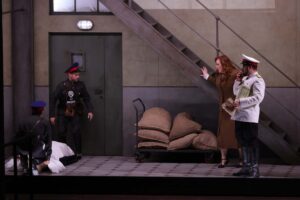
Barkhatov’s innovative staging employs a dual timeline, juxtaposing Katerina’s interrogation with flashbacks that recreate her tragic story. This approach allows for seamless transitions that engage the audience without confusion. The director notes that balancing the opera’s violent themes while maintaining clarity is critical, stating, “Lady Macbeth is simple and extremely difficult at the same time.”
The set design by Zinovy Margolin further enhances the production. It contrasts the opulence of a bourgeois restaurant with the oppressive interiors where Katerina’s suffering unfolds. Barkhatov’s vision avoids folkloric clichés, focusing instead on the psychological and political implications of the narrative. The visual representation of violence is intense yet never gratuitous, maintaining a respectful treatment of the themes.
Barkhatov’s most audacious decision comes in the reimagined ending. Instead of Katerina’s original fate of drowning, she ignites herself and Sonetka in a dramatic climax that leaves audiences awestruck. The impact of witnessing this fiery scene is visceral, with the heat palpable in the auditorium, thanks to the efforts of stuntwomen Beatrice Del Bo and Marie Schmitz, who execute this dangerous act with remarkable skill.
Musical Mastery and Stellar Performances
Conductor Riccardo Chailly marked his final season-opening appearance with a powerful interpretation of the score. His approach combined analytical clarity with a deep understanding of the opera’s multifaceted nature, avoiding excessive dramatization. Chailly’s leadership brought out the score’s harshness and lyrical beauty, creating a compelling narrative flow.
Despite a health scare during a performance on December 10, 2023, Chailly returned to conduct again just days later. His commitment to the production has been a defining element of its success. The Orchestra of Teatro alla Scala responded with exceptional artistry, particularly in the brass and percussion sections, capturing Shostakovich’s intense writing while maintaining control over the sound.
Soprano Sara Jakubiak delivered a commanding performance as Katerina, navigating the role’s complexities with technical precision and emotional depth. Her portrayal is not of a monster but of a deeply human character trapped in despair, effectively conveying Katerina’s journey from victimhood to defiance.
Tenor Najmiddin Mavlyanov provided a strong portrayal of Sergei, emphasizing the character’s opportunistic nature rather than romantic heroism. His performance aligns with Barkhatov’s vision, presenting Sergei as a catalyst for Katerina’s downfall. Bass Alexander Roslavets also shone as Boris, embodying the oppressive patriarch with a commanding presence that underscored the character’s brutality.
The supporting cast delivered strong performances, with Ekaterina Sannikova as Aksin’ya and Elena Maximova as Sonetka contributing to the overall impact of the production. The Teatro alla Scala Chorus, under Alberto Malazzi, functioned as a powerful collective, embodying the societal brutality integral to the opera’s themes.
As the curtain fell, the audience responded with resounding applause, particularly for Jakubiak and Chailly. The enduring resonance of Shostakovich’s work continues to challenge and provoke, echoing its original intent to critique power structures and institutionalized violence. This revival at Teatro alla Scala not only showcases the opera’s timeless relevance but also marks a significant moment in the current operatic landscape.