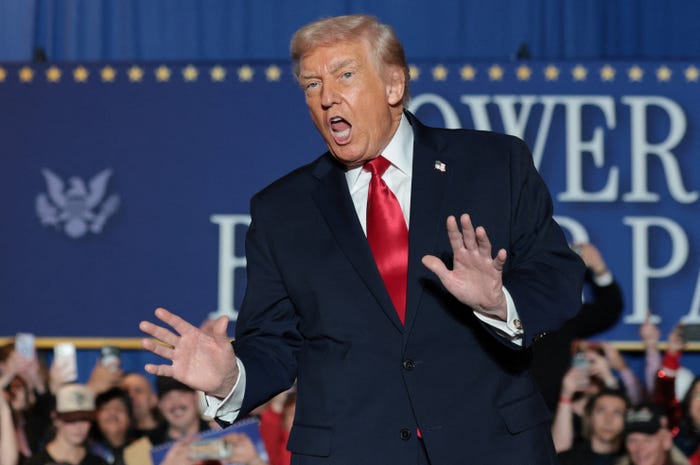
President Donald Trump is promoting a smaller trade deficit and increased tariff revenue as key achievements of his economic policies ahead of the midterm elections. He claims these indicators reflect an improving economy, although many economists argue that the reality is more complex and potentially troubling.
During recent events in swing states, Trump emphasized the importance of tariffs, stating, “Tariffs are bringing us hundreds of billions of dollars.” He further asserted that previous trade agreements made the United States vulnerable and ridiculed, but claimed that the nation is now respected on the global stage. The White House has pointed out that the trade deficit has narrowed to its smallest level since mid-2020, framing this as evidence that the America First trade agenda is effective.
Despite these assertions, economists caution that a reduced trade deficit does not necessarily indicate a healthy economy. According to Kimberly Clausing, a professor of tax law and policy at the UCLA School of Law, a smaller trade deficit can signal reduced consumer spending and investment, rather than economic prosperity. She stated, “In the United States in recent years, a declining trade deficit is often associated with a weak economy, due to reduced consumption and investment.”
The Bureau of Economic Analysis has reported a decline in both exports and imports, adjusted for inflation, over the three months leading up to August 2025. This trend suggests potential economic weakness, a theme echoed by Wayne Winegarden, a senior fellow at the Pacific Research Institute. He criticized the notion that reducing the trade deficit inherently benefits the economy, calling it a “complete red herring.” He argued that the trade deficit is not a meaningful measure of economic health, as it lacks correlation with affordability or growth.
As Trump continues to highlight these economic indicators, the U.S. labor market is showing signs of strain. The Bureau of Labor Statistics reported a loss of 105,000 jobs in October 2025, followed by a modest gain of 64,000 jobs in November. The unemployment rate rose to a four-year high of 4.6%. In manufacturing, employment figures have declined from 12,755,000 jobs in January 2025 to 12,706,000 by September 2025.
Amid these developments, the implications of tariff policies on consumer prices are becoming increasingly evident. A report from the Federal Reserve of St. Louis highlighted that tariffs have contributed to rising prices, with the cost increases closely correlating with tariff implementation. Jason Furman, a professor at the Harvard Kennedy School, noted that the perceived reduction in the trade deficit may be misleading, attributing it to a timing shift in imports rather than genuine improvement. He pointed out that the national trade deficit was actually $95.2 billion larger in the first nine months of 2025 compared to the same period in 2024.
While tariff revenues have increased, Furman emphasized that this income is largely offsetting other tax cuts initiated by the Trump administration. He added that a significant portion of tariff revenue is derived from American consumers facing higher prices. The White House has not yet responded to requests for further comment on these economic assessments.
As the midterm elections approach, the narrative around the trade deficit and tariffs continues to evolve, with contrasting views on their implications for the broader economy. The outcome of these discussions may play a crucial role in shaping public perception and electoral results.