UPDATE: Minnesota Governor Tim Walz and officials from the Department of Human Services (DHS) have just announced they lack evidence to support claims that Medicaid fraud could reach an astonishing $9 billion. This revelation comes on the heels of new charges filed by the U.S. Attorney’s Office against six individuals linked to Medicaid fraud in the state.
The U.S. Attorney’s Office revealed on Thursday that an audit of 14 “high risk” Medicaid programs since 2018 found total claims of $18 billion. First Assistant U.S. Attorney Joseph Thompson indicated that approximately “half or more” of these claims are believed to be fraudulent. However, state officials are pushing back against this estimate.
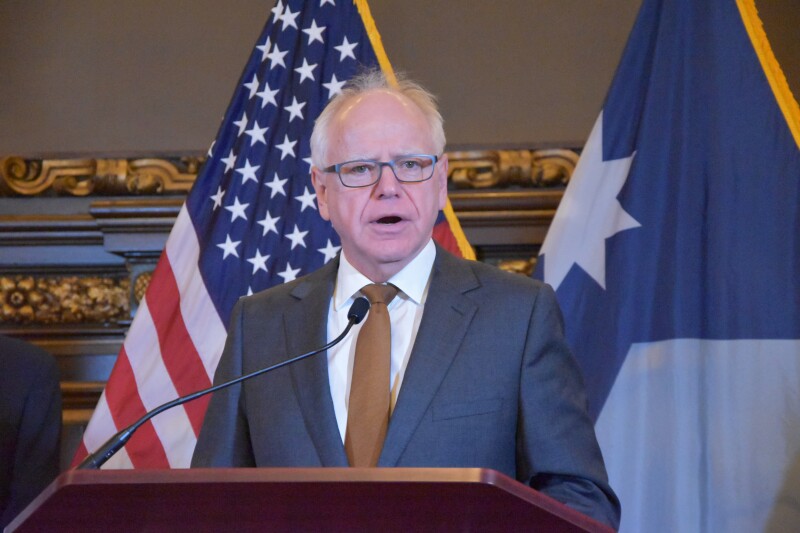
At a press conference on Friday, Walz labeled the $9 billion figure as mere “speculation,” emphasizing that such claims should be backed by solid proof. “To extrapolate what that number is for sensationalism… it doesn’t really help us,” Walz stated. DHS Inspector General James Clark echoed this sentiment, stating, “I haven’t seen any evidence or information to suggest that there’s $9 billion worth of Medicaid fraud.”
The urgency of this situation is compounded by what John Connolly, deputy commissioner and Medicaid director at DHS, described as “tens of millions of dollars” in confirmed fraud, a figure that does not account for other agencies like the Department of Education, which faces its own fraud crisis estimated at $250 million.
“If there is evidence, we need it so that we can stop payment,” Connolly urged, highlighting the critical state of the Medicaid system. He pointed out that of the $18 billion in claims, $6 billion went through managed care organizations, while $10 billion was subject to electronic visit verification, ensuring service providers’ accountability.
The stakes are high as Walz and DHS officials have taken proactive measures by halting payments to programs suspected of fraud. “We stopped payments on them in July and turned the case over to law enforcement to prosecute,” Walz confirmed, underscoring the state’s commitment to addressing fraud.
As the state grapples with these serious allegations, the political landscape has become increasingly charged. Tensions are rising between parties, with Walz criticizing Republican lawmakers for not cooperating in solving the fraud issue. “Nobody in the legislature on the Republican side is interested in solving this,” he lamented, suggesting that political motivations are complicating the fight against fraud.
This developing story highlights the ongoing battle against Medicaid fraud in Minnesota, raising concerns over trust in the system and the impact on legitimate service providers. As investigations continue, the demand for transparency and accountability grows stronger.
What happens next is crucial. State officials are calling for cooperation from the U.S. Attorney’s Office to provide the evidence needed for further action. With the specter of $9 billion in potential fraud looming, the urgency to act has never been more pressing. Stay tuned for updates as this situation unfolds.