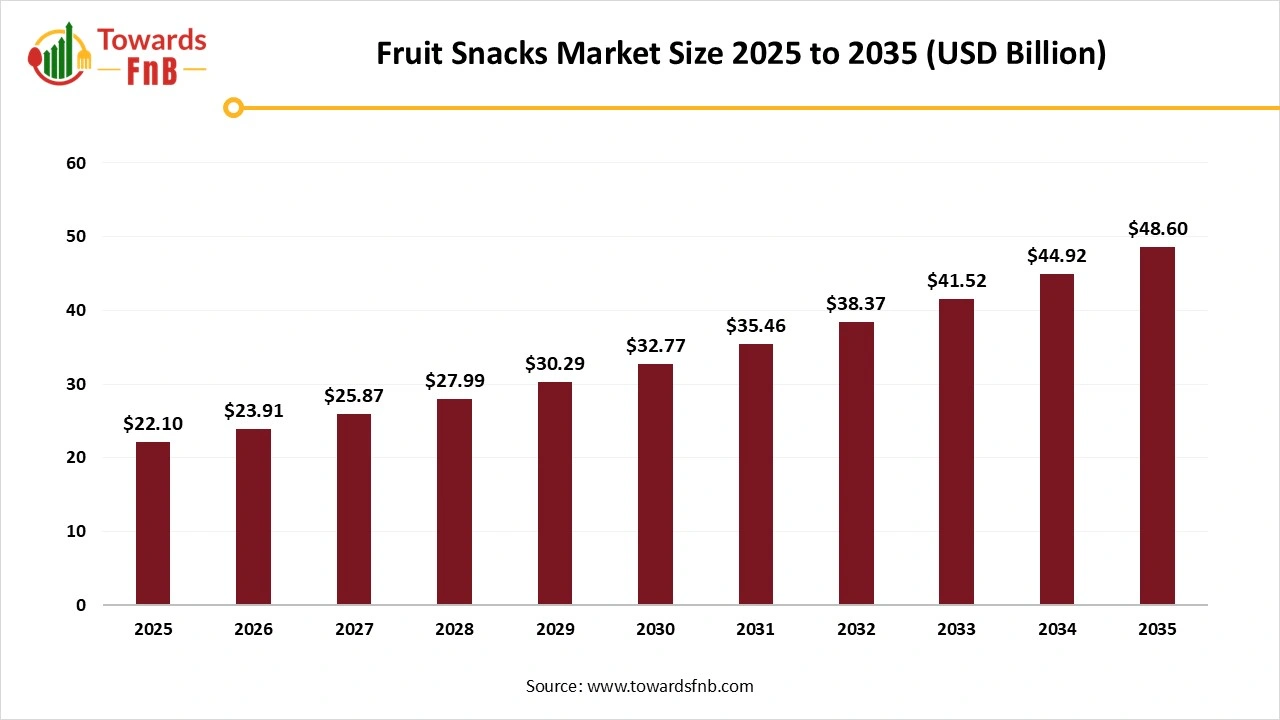
The global fruit snacks market, valued at USD 22.10 billion in 2025, is projected to nearly double in size, reaching approximately USD 48.60 billion by 2035. A report published by Towards FnB, a sister company of Precedence Research, outlines how various factors are driving this substantial growth.
Market expansion is being propelled by a surge in health-conscious consumers. As individuals increasingly seek snacks that are clean-label, organic, and minimally processed, fruit snacks have emerged as a preferred choice. The demand for lower-calorie alternatives to traditional confectionery is particularly noteworthy, with both adults and children gravitating towards healthier, convenient snacking options.
Market Dynamics and Trends
In 2025, North America held the largest market share at 42.8%, while the Asia Pacific region is anticipated to exhibit the fastest growth rate, with a compound annual growth rate (CAGR) of 8.0% from 2026 to 2035. The fruit gummies and chews segment led the market, accounting for 34.5% of the share, and is expected to continue its dominance, driven by consumer preferences for nutritious snacks.
The report further reveals that the mixed fruits segment contributed the largest share of 32.5% in 2025, with berries anticipated to grow at a CAGR of 7.0% during the forecast period. The conventional category led the market with a share of 68.7%, while the organic segment is predicted to grow at a notable CAGR of 7.4%.
Technological advancements are playing a crucial role in reshaping the fruit snacks market. Innovations in food processing and packaging are enhancing the shelf life and nutritional value of fruit snacks. Vidyesh Swar, Principal Consultant at Towards FnB, noted that clean-label reformulation, freeze-drying technology, and AI-enabled manufacturing are redefining the development and positioning of fruit snacks globally.
Health Consciousness and Technology Integration
The increasing consumer shift towards healthier snacking options is a significant driver for the fruit snacks industry. The market benefits from rising awareness surrounding calorie intake and sugar reduction, pushing consumers towards fat-free and low-sugar alternatives. The availability of various forms, including fresh, freeze-dried, and organic options, further supports growth.
Artificial intelligence is revolutionizing product development within the fruit snacks market. AI systems are utilized to enhance formulation accuracy, ensuring products meet health-focused consumer expectations. By analyzing various nutritional parameters, AI aids manufacturers in producing fruit snacks with optimal texture and flavor while minimizing added sugars.
Recent developments in the market highlight innovative product launches aimed at health-conscious consumers. Notably, David Beckham introduced BEEUP, a honey-based fruit snack designed to provide healthier options for families in June 2025. Additionally, a collaboration between The Smurfs and a Ukrainian confectionery brand aims to launch sugar-free fruit pastilles, targeting children globally.
The market’s outlook is further buoyed by the demand for transparency and clean-label options. As consumers increasingly seek fortified snacks enriched with essential nutrients, the fruit snacks market is positioned for continued growth.
With major players like Ferrero Group, Nestlé, and Haribo actively competing in this burgeoning market, the future of fruit snacks appears bright. The combination of health trends, technological advancements, and innovative product offerings is likely to keep the fruit snacks market on its upward trajectory.
As the sector evolves, companies and consumers alike will benefit from the expanding range of healthier, more convenient snacking options, ensuring that fruit snacks remain a staple in diets worldwide.