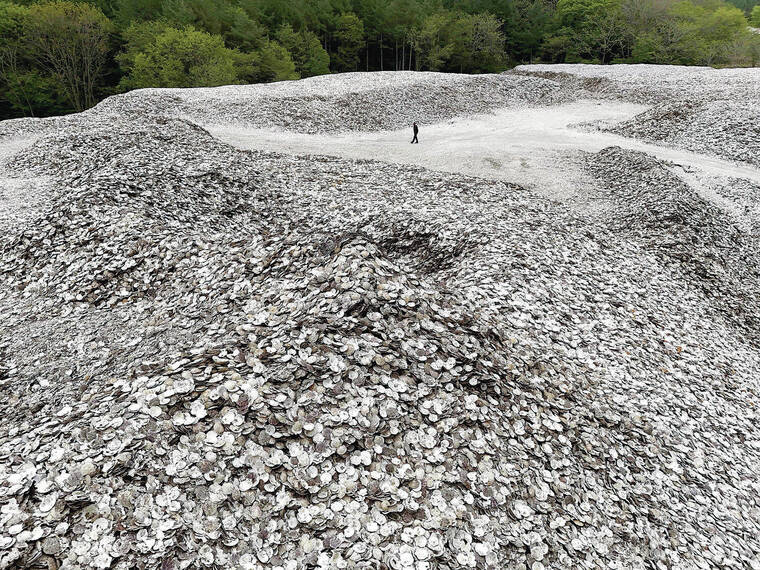
In Yubetsu, a town along the Sea of Okhotsk in Hokkaido, discarded scallop shells are transforming from waste into opportunity. Piles of white shells, reminiscent of winter snow, have accumulated on a lot managed by the processing company, Kyoritsu Sangyo. This situation arises from a decline in demand for shells due to rising prices associated with their traditional recycling into farmland drainage ditches. According to Masao Sasaki, president of Kyoritsu Sangyo, the company has faced an ongoing surplus of shells for several years.
Hokkaido is renowned for having the largest scallop catch in Japan. Each year, hundreds of thousands of tons of scallop shells are discarded, presenting a significant environmental challenge. The Hokkaido Research Organization, based in Sapporo, has been exploring innovative recycling methods for these shells. Notably, in 2005, the organization partnered with Nihon Rikagaku Industry Co. to develop a new type of chalk made from crushed scallop shells.
The chalk, produced from shells ground into particles measuring just 5 micrometers, has received positive feedback for its smoother application and enhanced durability compared to conventional products. Increasing environmental awareness has spotlighted scallop shells as a promising biomass material. When mixed with plastics, crushed shells can help reduce reliance on petroleum-based products.
This new material has already found practical applications, including the creation of food trays. Current tests are evaluating its potential for use in manufacturing interior car parts. Additionally, innovative designs such as “hotamet”—a blend of “helmet” and “hotate,” which means scallop in Japanese—were showcased as disaster equipment and bicycle safety gear at the upcoming 2025 Osaka-Kansai Expo. These helmets incorporate 10% crushed scallop shells, highlighting the versatility of this once-discarded material.
Kazuhito Nishikawa, head of the Nihon Rikagaku Industry plant in Bibai, Hokkaido, expressed surprise at the transformation of a chalk ingredient into a viable biomass material. “It’s so unexpected that a chalk ingredient could become biomass material,” he noted, underscoring the innovative potential of scallop shells.
As Hokkaido continues to adapt to changing market demands, the creative repurposing of scallop shells illustrates a forward-thinking approach to waste management and sustainability. This development not only addresses local environmental issues but also opens new avenues for economic growth in the region.