Research from Cornell University highlights how soil microbes influence carbon dynamics, revealing significant changes in molecular diversity during the decomposition of dead plants. This study, published in Nature Communications on December 10, 2023, is critical for understanding the role of soils in climate change mitigation. Soils hold three times more carbon than the atmosphere and all plants combined, making their function in carbon cycling essential.
The study indicates that molecular diversity in soil increases during the first month of plant decomposition, peaking at 32 days before declining. This pattern suggests a complex interplay between microbial activity and organic matter recycling, as researchers aim to determine how to retain or even increase soil carbon stocks. Senior author Johannes Lehmann, a professor of soil and crop sciences, emphasizes the importance of these findings in regulating atmospheric CO2 levels. “Even small, incremental changes can make a significant difference in the atmosphere and therefore for climate change,” he stated.
The research, led by first author Rachelle Davenport, formerly a graduate student in Lehmann’s lab, involved collaboration among 11 co-authors from seven institutions across six U.S. states and the Netherlands. Their work was supported by four public and private grants, which included funding from Cornell, such as the Schmittau-Novak Small Grant and a Graduate Research Grant from the Cornell Atkinson Center for Sustainability.
Historically, scientists believed that soil organic carbon accumulated primarily due to resistant plant materials. However, a pivotal paper co-authored by Lehmann in 2011 challenged this notion, suggesting that soil organic carbon stems from complex interactions among soil microorganisms, organic molecules, and minerals. This research called for new experiments to uncover mechanisms that affect carbon storage and release in soils.
In a follow-up theory proposed in 2020, Lehmann and colleagues posited that higher molecular diversity in soils could limit decomposition, potentially leading to greater carbon retention. The rationale is that a more diverse molecular pool makes it harder for microbes to specialize and efficiently decompose plant materials, thereby allowing more minerals to capture and store carbon long-term.
The current study is groundbreaking as it provides empirical evidence supporting the idea that plant decomposition temporarily enhances soil molecular diversity. “It’s been a long time coming… but we now have some empirical evidence that plant decomposition does increase molecular diversity, if only for a short time,” Lehmann noted.
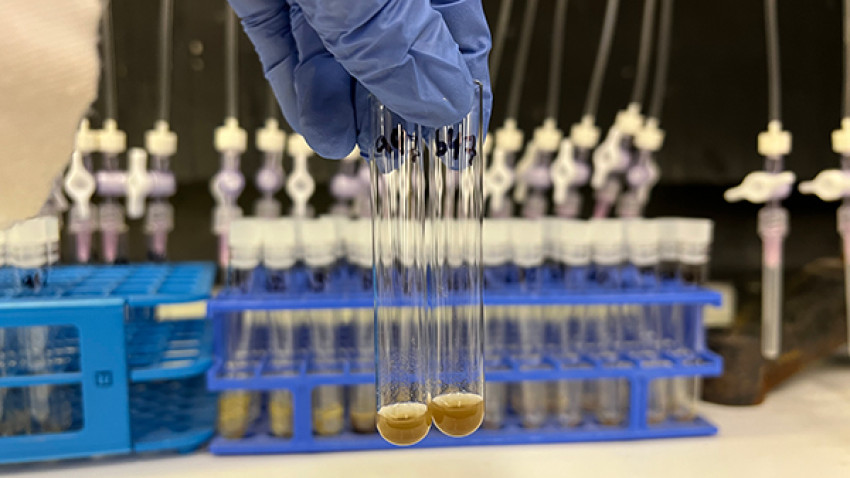
To assess molecular diversity, researchers extracted organic matter using water and identified compounds in the dissolved organic matter pool through high-resolution mass spectrometry. Notably, this study is the first to employ “18O heavy water” to track changes in soil molecular composition due to microbial activity. Davenport explained that traditional methods often use carbon or nitrogen labels, which can skew measurements of microbial activity. “When you trace activity via carbon, you usually feed microbes glucose… affecting their metabolism and then you’re not really accurately measuring microbial activity,” she said, underscoring the success of this innovative approach.
Davenport’s research received a Graduate Research Grant from Cornell Atkinson in 2022, which allowed her to hire an undergraduate student, Caleb Levitt, to assist with measuring soil carbon dioxide emissions and assessing the effects of decomposition on organic matter molecular diversity.
Looking ahead, the research team plans to investigate whether increased diversity among soil molecules, microorganisms, and minerals can lead to enhanced carbon storage in soils. If confirmed, the findings could inform strategies to promote this diversity through improved farming and forest management practices.
The study’s funding also included support from the U.S. National Institute for Food and Agriculture and the Pacific Northwest National Laboratory, illustrating a broad commitment to understanding and addressing climate change through soil science. As researchers continue to piece together the intricate puzzle of soil carbon dynamics, the implications for environmental sustainability remain profound.