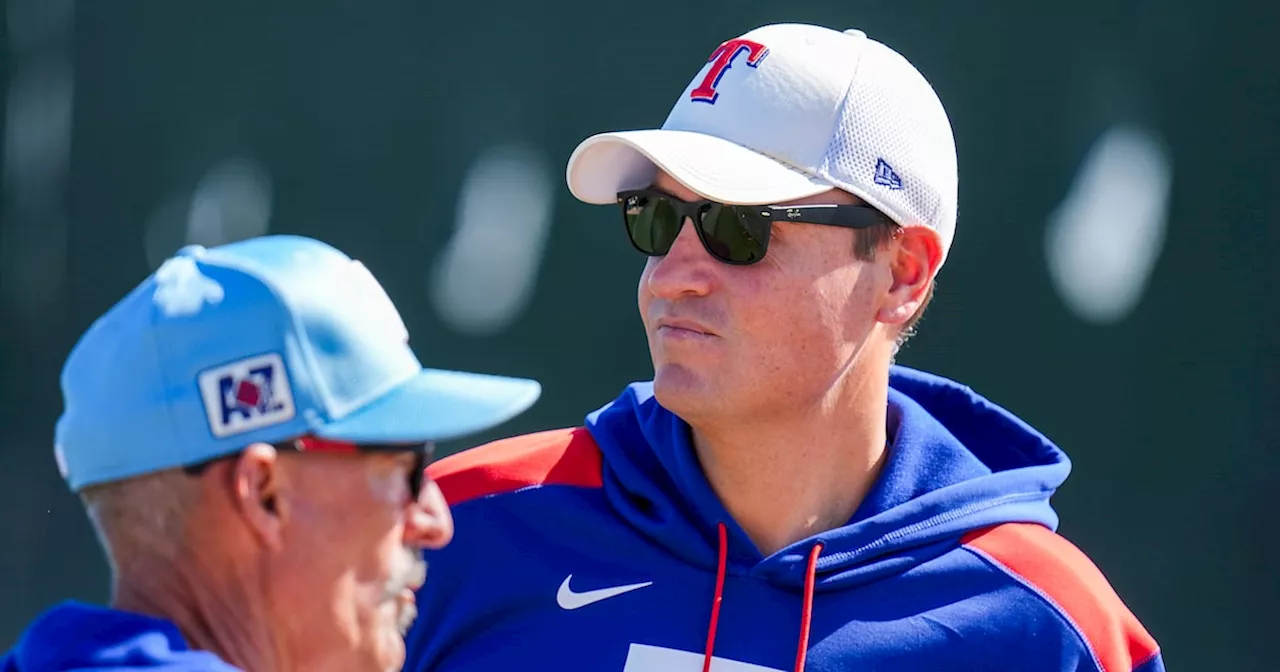
UPDATE: Chris Young, the Texas Rangers’ president of baseball operations, has delivered a passionate address focusing on the team’s payroll challenges and the urgent need for improved performance heading into the 2026 season. Speaking during the team’s spring training in Surprise, Arizona, Young emphasized that the Rangers’ $241.45 million payroll, which includes a significant luxury tax penalty, must translate into better results on the field.
Young’s comments come at a critical time as the Rangers look to rebound from two consecutive seasons without postseason appearances, despite high spending. “It’s not about the payroll; it’s about performance,” Young stated emphatically, highlighting that many playoff teams last year operated with lower budgets. The urgency to shift focus from spending to internal improvement has never been clearer.
While the Rangers exceeded the luxury tax for the third straight year, resulting in a hefty tax bill, Young acknowledged that their $2.98 million per win spending has not yielded the expected outcomes. “We just haven’t performed,” he admitted, reflecting on the team’s disappointing trajectory. Young’s remarks underscore the pressing need for the Rangers to recalibrate their approach and cultivate a more competitive environment.
Amid uncertainty around local broadcasting revenues and potential league-wide changes, Young pointed out that merely throwing money at problems has not guaranteed success. “Teams that spent hundreds of millions last year didn’t make the playoffs. We were one of them,” he noted. This sentiment resonates deeply as the Rangers aim to maximize efficiency and effectiveness without overspending.
Moving forward, Young remains optimistic about the talent within the organization. He stressed the importance of internal hunger and determination, stating, “There is not one person in this organization that does not have something to prove.” He called for a collective commitment to grit and determination as the team prepares for the upcoming season.
In terms of specific needs, Young identified the necessity for additional bullpen arms, an extra bat, and rotational depth. He is committed to making strategic additions while operating within a yet-to-be-disclosed budget. “The biggest improvements we can make in 2026 are all well within the margins,” he assured, indicating a focus on skill development rather than just acquisitions.
As the Rangers gear up for the new season, all eyes will be on how they adjust their strategy to foster growth and improve performance. The urgency for change is palpable, and the organization’s future may hinge on its ability to embrace this new direction.
Stay tuned for more updates as the Texas Rangers aim to transform their approach and break past the barriers of underperformance. This is a developing story with significant implications for fans and stakeholders alike.