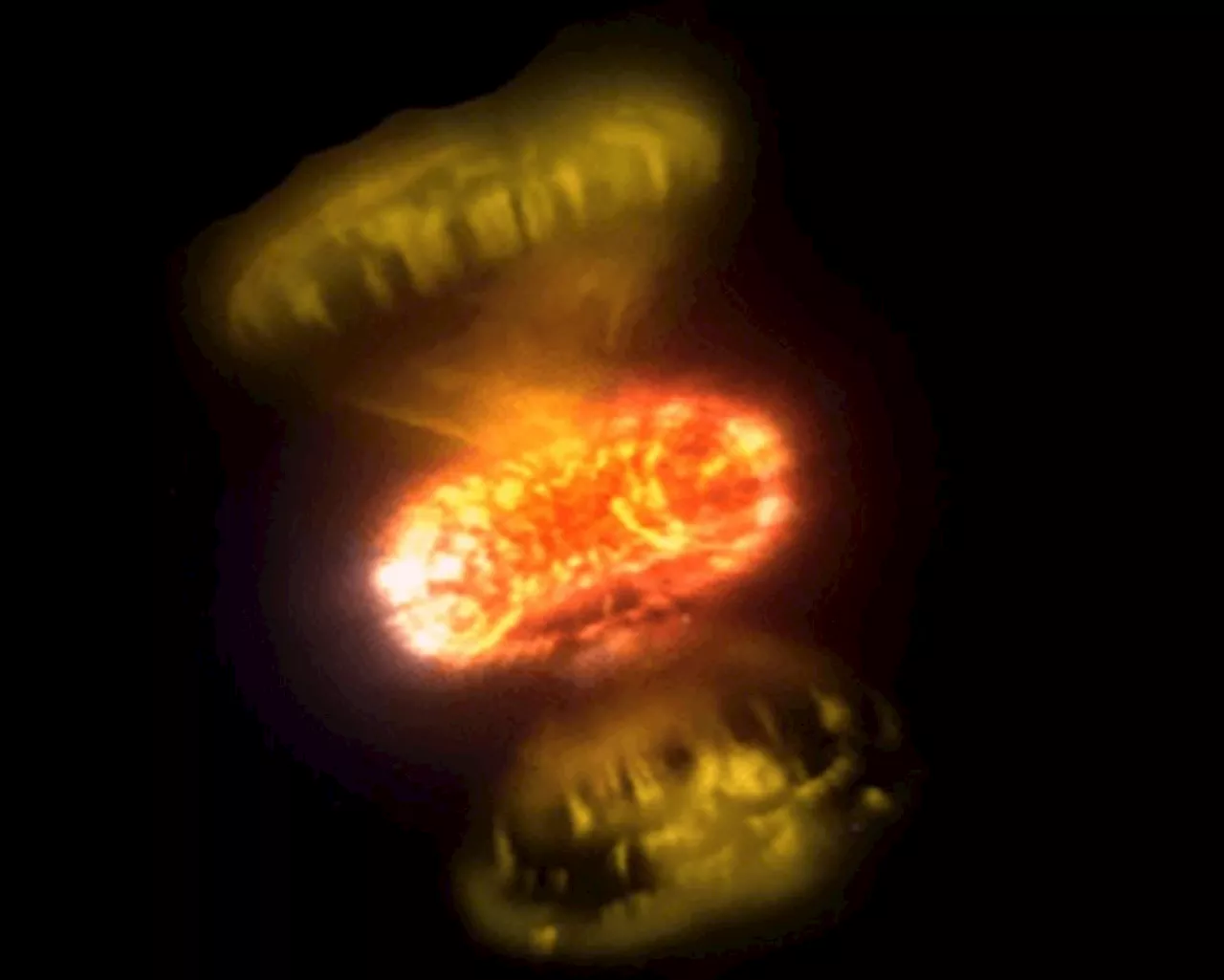
Astronomers have unveiled detailed images of nova explosions, providing unprecedented insights into these stellar phenomena. The observations, published in the journal Nature Astronomy, reveal a level of complexity that challenges previous assumptions about these events, particularly their thermonuclear eruptions on white dwarfs in binary systems.
Nova explosions occur when a white dwarf accumulates matter from its companion star, leading to a sudden thermonuclear explosion. The recent findings indicate that these explosions are more intricate than previously believed, featuring multiple ejections and shock physics, as well as the formation of high-energy gamma-ray emissions. The research, led by Elias Aydi from Texas Tech University, highlights two specific novae, V1674 Her and V1405 Cas, each offering unique insights into the mechanisms of nova events.
Complexity Unveiled in Nova Explosions
The study illustrates that V1674 Her is classified as a fast nova, with images captured just two to three days after the explosion revealing multiple interacting ejections. This rapid flaring and subsequent fading illustrate a dynamic interplay between the expelled material. Conversely, V1405 Cas is categorized as a slow nova, with significant ejections occurring over 50 days after the initial explosion, marking the first evidence of delayed ejection in novae.
According to Aydi, “These observations allow us to watch a stellar explosion in real time, something that is very complicated and has long been thought to be extremely challenging.” The ability to observe these events in detail transforms our understanding from a mere flash of light to a complex series of interactions.
The researchers employed two methodologies—interferometry and spectrometry—to study the novae. The Georgia State University CHARA Array facilitated the interferometric observations, revealing intricate details of the explosions. Spectrometry data from various observatories helped identify chemical signatures in the ejecta as it evolved. The alignment of spectral data with the structures revealed through interferometry confirms the interactions among the material flows.
Implications for Astrophysics
This research establishes novae as valuable laboratories for studying extreme astrophysical environments. As noted by co-author John Monnier from University of Michigan, the ability to observe the structure of ejected material provides significant insight into the mechanics of stellar explosions. “This is an extraordinary leap forward,” Monnier stated, emphasizing the importance of these observations in understanding the nature of such dramatic cosmic events.
The formation mechanisms of energetic shocks leading to gamma-ray emissions remain poorly understood. The authors suggest that these shocks may be generated internally within the ejecta, at the interface of multiple ejections, possibly leading to new discoveries about particle acceleration and shock physics.
Professor Laura Chomiuk from Michigan State University reinforced the significance of these findings, explaining that novae are not merely fireworks in our galaxy but critical to understanding extreme physics. “By seeing how and when the material is ejected, we can finally connect the dots between the nuclear reactions on the star’s surface, the geometry of the ejected material, and the high-energy radiation we detect from space.”
As researchers continue to analyze these complex events, they aim to gather more data to ascertain whether the delayed ejection observed in V1405 Cas is common among other novae. This could establish novae as key sites for further exploration of common-envelope interactions and stellar evolution.
In conclusion, the study of nova explosions is evolving, revealing layers of complexity that challenge traditional views. As Aydi remarked, “With more observations like these, we can finally start answering big questions about how stars live, die, and affect their surroundings.” The new findings mark a significant advancement in our understanding of stellar phenomena and underscore the importance of ongoing astronomical research.